
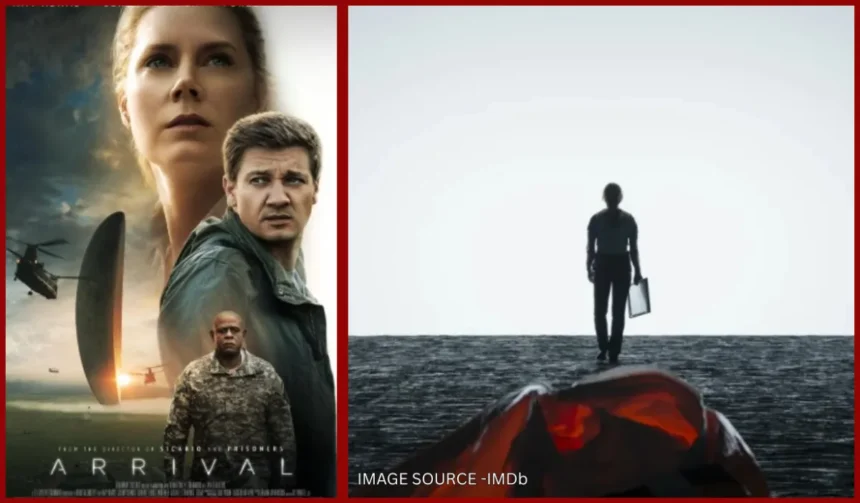
Arrival (2016)
A Sci-Fi Masterpiece of Time, Language, and Love
🗓️ Release Year
2016
📺 Streaming On
Paramount+
IMDb
7.9/10
Rotten Tomatoes
94%
Certified Fresh
1. Introduction
Denis Villeneuve’s Arrival is not your typical alien invasion movie. It’s a profound, cerebral science fiction film that uses the concept of first contact to explore the very nature of time, memory, and human connection. If you found its nonlinear narrative challenging, you’re not alone.
This Movie Explained + Ending Explained guide is designed to unpack the layered story of linguist Louise Banks. We’ll break down the plot step-by-step, decipher the heptapods’ circular language, and fully explain the film’s heartbreaking and mind-expanding conclusion. Prepare to see Arrival in a whole new light.
2. Overview
Arrival is a 2016 sci-fi drama directed by Denis Villeneuve, with a brilliant screenplay by Eric Heisserer based on Ted Chiang’s story “Story of Your Life.” It runs for 116 minutes and is rated PG-13.
The film’s mood is contemplative, somber, and awe-inspiring, favoring slow-burn tension over action spectacles. Its core genres are science fiction and philosophical drama, with a deeply emotional throughline about love and loss. The cinematography, by Bradford Young, is famously muted, using grays, blues, and stark landscapes to create a sense of profound gravity.
3. SPOILER WARNING
⚠️ SPOILER ALERT ⚠️
This article contains full spoilers for Arrival (2016), including detailed breakdowns of major plot points, character arcs, and the ending. Proceed only if you’ve seen the film.
4. Story Explained (Full Breakdown)
Act 1 Explained: First Contact
The film opens with linguist Dr. Louise Banks living a life shadowed by grief, mourning the loss of her young daughter to a rare disease. Her quiet academic life is shattered when 12 mysterious, monolithic spacecraft appear at random locations across Earth.
The U.S. military, led by Colonel Weber, recruits Louise and theoretical physicist Ian Donnelly to a Montana site near one of the ships. Their mission: establish communication and determine the aliens’ intent. The aliens, dubbed “heptapods,” are seven-limbed creatures who communicate through complex, inky circular symbols.
Louise insists that to understand their purpose, she must first understand their language. Through painstaking, dangerous sessions inside the ship’s gravity-defying chamber, she begins to learn their logographic writing system.
Act 2 Explained: The Weapon of Language
As Louise learns the heptapod language, she experiences vivid, non-chronological “flashes” of a young girl—her daughter, Hannah. She dismisses them as traumatic memories or dreams. Meanwhile, global tension escalates. Other nations, particularly China, interpret a heptapod symbol as “weapon,” leading to a brink of war.
Louise realizes the heptapods’ written language is nonlinear. It perceives time not as a sequential line but as a whole, where past, present, and future coexist. Learning this language begins to rewire her own perception of time. In a desperate gambit to avoid global conflict, she risks her life to enter the ship alone and ask the ultimate question: “What is your purpose on Earth?”
Act 3 Explained: The Gift and The Choice
The heptapods reveal their purpose: they have come to offer humanity their language as a “tool” or “weapon.” This “weapon” is the ability to perceive time as they do. Louise’s “flashes” of Hannah are not memories—they are future memories. Her daughter has not yet been born, and will die young.
Armed with this new perception, Louise accesses a future memory where a global unity event reveals a crucial piece of information: the Chinese General Shang’s private phone number and his dying wife’s last words. In the present, she uses this “future” knowledge to call Shang, deliver the message, and avert war. The ships depart, leaving humanity forever changed.

5. Key Themes Explained
Time and Free Will: The film’s central puzzle asks: If you see your entire life from beginning to end, would you change your choices? The heptapod language suggests that knowing the future doesn’t negate free will; it completes it. We choose the path that creates the future we see.
Language Shapes Reality: The Sapir-Whorf hypothesis is the film’s engine. Louise doesn’t just learn to speak heptapod; she learns to think in it, which literally grants her a new perception of reality. Language is presented as the ultimate technology.
The Unity of Experience: The film argues that joy and sorrow are inextricably linked. Louise’s profound love for her daughter is made more poignant, not less, by the foreknowledge of her loss. The heptapods’ gift is meant to unify humanity across time and space, emphasizing collaboration over conflict.
Memory vs. Prophecy: The narrative brilliantly blurs the line between memory and premonition. This forces the audience to experience time as Louise eventually does—not as a sequence of events, but as a tapestry where every thread is equally present.
6. Characters Explained
Dr. Louise Banks (Amy Adams): A linguist defined by grief who becomes humanity’s most important translator. Her arc is about embracing a painful future with full awareness and choosing love despite the cost. She transforms from a person living in the past to one who experiences time in its totality.
Ian Donnelly (Jeremy Renner): A physicist who provides the scientific counterpoint to Louise’s linguistic approach. He represents curiosity and logic, but ultimately, he is the one who falls in love with Louise and fathers Hannah, unaware of the future she already knows.
Colonel Weber (Forest Whitaker): The military conduit, representing humanity’s instinctive fear and aggression in the face of the unknown. His journey is one of learning to trust a process (linguistics) he doesn’t understand over the brute force he’s accustomed to.
The Heptapods (Abbott and Costello): They are not invaders but “teachers.” Their motivation is altruistic—to give humanity a tool for its future survival (hinted to be needed 3,000 years later). Their non-linear existence makes them patient, peaceful beings.

7. Twist Explained
The film’s brilliant twist recontextualizes everything. The poignant scenes of Louise with her daughter, Hannah, which we assume are flashbacks, are actually flash-forwards.
This isn’t a story about a woman grieving a past loss. It’s about a woman who, upon learning an alien language, gains the ability to see her future—a future that includes a beautiful daughter who will die young, and a divorce from the man she loves when he learns she chose this path knowing the pain ahead.
The twist isn’t just for shock value. It’s the ultimate demonstration of the film’s theme: experiencing time holistically. The “memory” of Hannah’s death is what gives Louise the strength and perspective to save the world in the present.
8. Movie Ending Explained
What Exactly Happens
After the heptapods depart, time jumps forward. Louise is with Ian, and they are a couple. She asks him, “If you could see your whole life from start to finish, would you change things?” He says he wouldn’t. The film then reveals the full sequence of her future: Hannah’s birth, her joyous childhood, Ian’s devastation when Louise finally confesses she knew Hannah would die, their subsequent split, and Hannah’s death in her teens.
The final scene returns to the present, just after the ships have left. Ian approaches Louise and asks, “Do you want to make a baby?” With the full weight of her future joy and sorrow in her heart, she smiles and says, “Yes.” She actively chooses the entire journey.
What the Ending Means
The ending is a powerful affirmation of life and love, even in the face of inevitable loss. Louise’s “Yes” is the ultimate act of free will. Knowing the pain does not deter her; it makes her choice to love more courageous and meaningful.
It completes the heptapods’ gift. The “tool” wasn’t just to save humanity from war in 2016, but to equip individuals like Louise with the perspective to embrace the full, tragic, beautiful spectrum of existence.
How It Connects to the Theme
The ending is the thesis statement. The entire film explores whether seeing the future robs you of your present. Louise’s decision proves it doesn’t. It deepens it. Her life becomes a unified whole, where the end is present at the beginning, and love is worth the predetermined pain.
Alternate Interpretations
Some viewers question if Louise’s visions are entirely reliable or if the future can be changed. The film strongly suggests a deterministic, “closed loop” timeline. However, an alternate reading is that her actions based on the visions create that specific future, making it a self-fulfilling prophecy of love.
Director’s Intention
Denis Villeneuve has stated the film is about “the beauty of the journey” and “embracing your destiny.” He aimed to craft an emotional experience that uses sci-fi concepts to explore the most human of dilemmas: how we live with the knowledge of death and loss.

9. Performances
Amy Adams delivers a career-best performance, internalizing the film’s colossal themes. Her work is in subtle glances, slight tremors, and a profound depth of sadness and wonder. She makes the cerebral concept emotionally visceral. Jeremy Renner provides grounded warmth and intellectual enthusiasm, making Ian a believable and sympathetic partner. Forest Whitaker expertly portrays the tension of a soldier relying on intellectuals in a crisis.
10. Direction & Visuals
Denis Villeneuve’s direction is patient, majestic, and deeply atmospheric. He builds awe not with explosions, but with the slow, silent rise of the humans into the heptapod ship. The production design is minimalist and monumental. The ships are simple, mysterious obsidian ellipses.
Cinematographer Bradford Young uses a desaturated, foggy, and gray-heavy palette, mirroring Louise’s mental state and the global anxiety. This makes the warm, sun-drenched “memories” of Hannah stand out emotionally. The heptapod ink, swirling into circular symbols, is one of the most iconic and meaningful visual creations in modern sci-fi.
11. Pros and Cons
Pros:
- Intelligent, thought-provoking screenplay that respects the audience.
- A powerful, emotional core that grounds high-concept sci-fi.
- Stunning, minimalist visual design and atmospheric score by Jóhann Jóhannsson.
- A perfect, thematically cohesive twist that rewards rewatches.
Cons:
- Deliberately slow pace may frustrate viewers seeking action.
- The core linguistic/scientific concepts can be challenging on a first watch.
- The global political subplot, while necessary, feels slightly simplistic compared to the main narrative’s depth.
12. Cast
| Actor/Actress | Character | Role Description |
|---|---|---|
| Amy Adams | Dr. Louise Banks | Renowned linguist tasked with communicating with the aliens. |
| Jeremy Renner | Ian Donnelly | Theoretical physicist and Louise’s partner in the mission. |
| Forest Whitaker | Colonel Weber | U.S. Army officer overseeing the Montana landing site. |
| Michael Stuhlbarg | Agent Halpern | CIA operative with a suspicious, hawkish stance. |
| Tzi Ma | General Shang | Chinese military leader whose actions push the world toward war. |
13. Crew
| Role | Name | Notable Contribution |
|---|---|---|
| Director | Denis Villeneuve | Orchestrated the film’s profound, atmospheric tone. |
| Screenwriter | Eric Heisserer | Adapted Ted Chiang’s complex short story for the screen. |
| Cinematographer | Bradford Young | Created the film’s iconic muted, ethereal visual style. |
| Composer | Jóhann Jóhannsson | Scored the film with haunting, minimalist soundscapes. |
| Editor | Joe Walker | Seamlessly wove together the non-linear timelines. |
| Source Author | Ted Chiang | Wrote the original story, “Story of Your Life.” |
14. Who Should Watch?
- Fans of cerebral, philosophical science fiction like 2001: A Space Odyssey or Contact.
- Viewers who appreciate character-driven drama over special effects spectacles.
- Anyone interested in linguistics, physics, and the nature of time.
- Those prepared for a meditative, emotionally resonant experience.
15. Verdict
Arrival is a modern science fiction masterpiece. It succeeds brilliantly on every level: as a tense first-contact thriller, a mind-bending exploration of theoretical concepts, and, most importantly, as a devastatingly beautiful story about love, loss, and the courage to embrace a life in its entirety. It is a film that lingers, challenges, and deepens with each viewing.
16. Reviews & Rankings
| Source | Score | Verdict Excerpt |
|---|---|---|
| Rotten Tomatoes | 94% (Certified Fresh) | “Arrival delivers a must-see experience for fans of thinking person’s sci-fi that anchors its heady themes with genuinely affecting emotion.” |
| IMDb User Score | 7.9/10 | A consensus of “intelligent, mesmerizing, and profound.” |
| Metacritic | 81/100 | “Universal acclaim based on its ambitious themes and execution.” |
Award Wins: It won the Academy Award for Best Sound Editing and was nominated for 7 others, including Best Picture, Best Director, and Best Adapted Screenplay.
17. Where to Watch
As of this writing, Arrival (2016) is available to stream on Paramount+ in several regions. It is also available for digital rental/purchase on platforms like Amazon Prime Video, Apple TV, and Google Play.
Ready to experience it with new understanding?
Watch “Arrival” on Paramount+ and see the masterpiece anew.


