
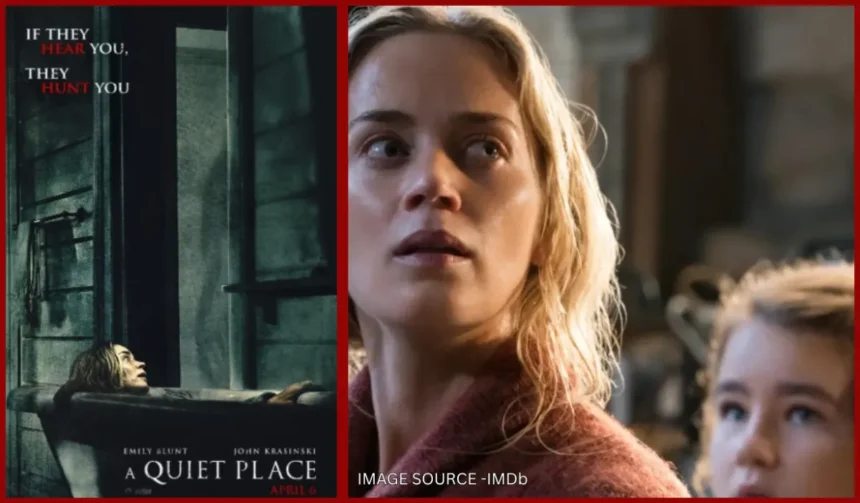
A Quiet Place (2018): Movie Explained + Ending Explained
Silence is Survival. Sound is Death.
🗓️ Release Year
2018
📺 Streaming On
Paramount+
IMDb
7.5/10
Rotten Tomatoes
96%
Critics Score
1. A Quiet Place (2018): Story Breakdown and Ending Explained
If you can hear them, you’re already dead. This is the terrifying rule of the world in John Krasinski’s 2018 horror masterpiece, A Quiet Place. More than just a monster movie, it’s a nerve-shredding exploration of family, grief, and the lengths we go to protect our loved ones.
This movie explained and ending explained guide will walk you through the entire film. We’ll break down the plot act by act, uncover the deeper themes, analyze the characters’ motivations, and, most importantly, dissect that iconic, powerful ending. Whether you just watched it and have questions, or you’re curious about the hype, this is your complete spoiler-filled analysis.
2. Overview
A Quiet Place is a post-apocalyptic horror-thriller that redefined the genre with its brilliant use of sound—or the lack thereof. The movie runs for a tight 90 minutes, creating an atmosphere of unbearable tension from the first scene to the last.
The mood is one of constant, palpable dread, punctuated by moments of profound tenderness. It’s a film where a dropped picture frame or a stubbed toe can mean instant death. Directed by and starring John Krasinski, alongside real-life wife Emily Blunt, the film blends high-concept sci-fi with raw, emotional family drama.
⚠️ MAJOR SPOILER WARNING ⚠️
This article contains a full, detailed breakdown of A Quiet Place, including all major plot points, character deaths, and the ending. Please watch the movie first for the intended experience.
4. Story Explained (Full Breakdown)
Act 1: The Rules of Silence
The film opens on Day 89 after mysterious, deadly creatures have decimated the human population. We meet the Abbott family: father Lee, mother Evelyn, and their children Regan, Marcus, and Beau. They move silently through an abandoned town, gathering supplies.
We learn the core rule: the blind monsters hunt by acute sound. The family communicates via sign language (their daughter, Regan, is deaf). Tragedy strikes immediately. Young Beau finds a toy space shuttle that makes noise. Despite Lee’s frantic efforts, the creature kills Beau. This devastating prologue establishes the stakes and the family’s unspoken grief.
Act 2: Grief, Pregnancy, and Rising Tensions
We jump to Day 472. Evelyn is heavily pregnant, a terrifying prospect in a world where a baby’s cry is a death sentence. Lee works obsessively to find a way to protect his family, experimenting with hearing aid frequencies to potentially weaponize sound against the creatures.
Tension simmers between Lee and Regan, who blames herself for Beau’s death because she gave him the battery-operated toy. Lee, meanwhile, is desperate to fix her cochlear implant, a symbol of his need to fix what he perceives as broken and protect her. Marcus discovers the gruesome fate of their neighbors, a stark reminder of the outside threat.
Act 3: The Nightmare Unfolds
The third act is a relentless siege. Evelyn goes into labor alone in the house. She steps on a nail, stifling a scream, and attracts a creature. Simultaneously, Lee and Marcus are away, and Regan is in the basement. The film cross-cuts between three simultaneous crises.
Evelyn delivers the baby while evading the creature in the house. Lee and Marcus are trapped at a flooding grain silo. Regan, in the basement, sees a newspaper headline revealing the creatures’ weakness: they are vulnerable to high-frequency audio feedback. All threads converge when Lee sacrifices himself to save Marcus and Regan, screaming to draw the creature’s attention—his first and last loud sound in the film.

5. Key Themes Explained
Family and Sacrifice: At its core, this is a movie about parenthood. Every action Lee and Evelyn take is to ensure their children’s survival. Lee’s ultimate sacrifice is the purest expression of this theme. Their love is communicated not through words, but through protective gestures and shared looks.
Communication in Silence: The film brilliantly inverts communication. The most profound connections happen without sound. Sign language becomes their love language. The conflict with Regan stems from a lack of emotional communication, not auditory.
Grief and Guilt: The family is paralyzed not just by monsters, but by grief over Beau. Regan’s guilt and Lee’s futile attempts to “fix” her implant represent the struggle to move past trauma in a world that offers no room to heal.
Adaptation and Resilience: Humanity’s triumph is shown not through firepower, but through clever adaptation—sand paths, painted floorboards, a soundproof crib for the newborn. Survival is about intelligence and resilience.
6. Characters Explained
Lee Abbott (John Krasinski): The protector and engineer. His arc is from a father who believes he must have all the answers to one who realizes his greatest strength is his willingness to die for his children. His failed attempts to fix Regan’s implant mirror his feeling of failure to protect Beau.
Evelyn Abbott (Emily Blunt): The heart and fierce maternal force. She embodies quiet strength. Her journey through childbirth in total silence is one of cinema’s most intense sequences. She represents the enduring, fighting spirit of life itself in a world of death.
Regan Abbott (Millicent Simmonds): The emotional core. A deaf teenager wrestling with immense guilt and feeling like a burden. Her arc is about discovering her perceived weakness—her deafness and the cochlear implant’s feedback—is actually the family’s ultimate weapon. She transforms from a guilt-ridden girl to the savior.
Marcus Abbott (Noah Jupe): Represents fear and the loss of childhood. He is often terrified, but his love for his family forces him to be brave. He is the witness to the horror, the character through whom we often feel the sheer terror of their situation.
7. Twist Explained
The film’s major twist isn’t a narrative sleight of hand, but a revelation of information the characters already had: the monsters’ weakness to high-frequency sound.
The twist is delivered through Regan’s perspective. While hiding in the basement, she sees a framed newspaper article with the headline “IT’S SOUND!” and diagrams showing the creatures’ armor-like heads and their vulnerability to specific audio frequencies.
The brilliance is that the “weapon” was with them all along. Regan’s malfunctioning cochlear implant, which Lee kept trying to fix, generates the exact high-pitched feedback that causes the creatures physical pain and exposes their vulnerable inner ears. The thing that made her feel broken becomes the key to survival.

8. Movie Ending Explained
What Exactly Happens?
After Lee’s sacrifice, Regan and Marcus reunite with Evelyn and the newborn in the basement. The creatures are still a threat. Remembering the newspaper article, Regan has a realization. She takes the microphone from her implant and places it against the amplifier her father had been using for his experiments.
She generates a piercing screech of audio feedback. The creature attacking them writhes in agony, its armored head plates pulling back to expose its sensitive, fleshy inner ear. Seeing this, Evelyn grabs Lee’s shotgun and shoots the creature directly in the exposed weakness, killing it.
The film ends with Evelyn loading the shotgun, looking at Regan with newfound hope and resolve. They have found the weapon. They are no longer just surviving. They are fighting back.
What The Ending Means & How It Connects to Themes
The ending is a perfect resolution of the film’s central themes. Family: Lee’s sacrifice provided the moment for Regan’s discovery. His work (the amplifier) combined with her “flaw” (the implant) creates salvation. The family unit, though wounded, is now stronger and active.
Communication: The final act is a wordless symphony of understanding. A look between Evelyn and Regan says everything. They have finally communicated the path forward.
Empowerment: Regan’s arc completes. She is no longer the guilty child or a burden. She is the hero. Her disability is the advantage. The film argues that in a new world, old paradigms of “weakness” and “strength” are reversed.
Director’s Intention & Setup for Sequel
John Krasinski has stated the ending is about “hope” and the passing of the torch. Lee’s death was necessary for the children to step up. The final shot isn’t just about killing one monster; it’s a declaration of war. Evelyn cocks the shotgun, symbolizing their transition from prey to hunters.
This ending directly sets up the sequel, A Quiet Place Part II, which explores how this discovery spreads and whether there are other survivors. It shifts the genre from pure survival horror to a more active resistance story.
9. Performances
The acting in A Quiet Place is a masterclass in physical and emotional expression.
Emily Blunt gives a performance of breathtaking intensity and subtlety. The childbirth scene alone, where she must convey excruciating pain in utter silence, is award-worthy. Her eyes tell a story of fear, determination, and love in every frame.
John Krasinski portrays the weight of paternal responsibility with every strained look and careful movement. His final scene, expressing love, apology, and sacrifice to Regan entirely in sign language and through tears, is heartbreaking.
Millicent Simmonds, a deaf actress in real life, is the film’s soul. She brings an authentic, raw vulnerability and simmering anger that grounds the film. Her performance makes Regan’s empowerment at the end incredibly earned and moving.
Noah Jupe perfectly captures the visceral fear of a child in an impossible situation, making his moments of courage all the more impactful.
10. Direction & Visuals
John Krasinski’s direction is confident and inventive. The sound design is, of course, a character itself. The use of silence amplifies every tiny noise—a rustle, a breath—to jump-scare levels. The score by Marco Beltrami is used sparingly but effectively.
Cinematographer Charlotte Bruus Christensen uses a naturalistic, often muted color palette of greys and blues, making the rare splashes of color (the red warning lights, the crimson nail) deeply ominous. The camera often stays at a child’s eye level, immersing us in their vulnerability.
Visual symbolism is rich: the river representing both life (fishing) and death (Beau’s toy washed away); the nail piercing the wood like a spike of impending doom; the cornfield both a source of food and a terrifying, opaque maze.
11. Pros and Cons
Pros:
- Incredibly original and executed high-concept premise.
- Masterful building of tension through sound (and lack thereof).
- Powerful, emotional core that elevates it beyond standard horror.
- Stellar, nuanced performances from the entire cast.
- Tight, efficient 90-minute runtime with no filler.
Cons:
- Some logical world-building questions are left unanswered (e.g., the exact origin of the creatures).
- The “newspaper clipping” revelation can feel slightly convenient.
- The intense, quiet atmosphere may not appeal to viewers seeking action-packed horror.
12. Cast
| Actor | Character | Role |
|---|---|---|
| Emily Blunt | Evelyn Abbott | The mother, resilient and fierce protector. |
| John Krasinski | Lee Abbott | The father, engineer, and devoted protector. |
| Millicent Simmonds | Regan Abbott | Deaf eldest daughter, pivotal to the family’s survival. |
| Noah Jupe | Marcus Abbott | The younger son, fearful but courageous. |
| Cade Woodward | Beau Abbott | The youngest son (in prologue). |
13. Crew
| Role | Name | Contribution |
|---|---|---|
| Director / Co-Writer | John Krasinski | Visionary director and co-architect of the story and tension. |
| Co-Writer | Bryan Woods & Scott Beck | Wrote the original screenplay on which the film is based. |
| Cinematographer | Charlotte Bruus Christensen | Created the film’s haunting, immersive visual language. |
| Composer | Marco Beltrami | Crafted the minimalist, suspenseful score. |
| Sound Editors | Ethan Van der Ryn & Erik Aadahl | Oscar-nominated for making silence and sound the film’s central terror. |
14. Who Should Watch?
- Horror fans looking for intelligent, atmospheric scares over gore.
- Viewers who appreciate strong family dramas with emotional depth.
- Cinephiles interested in innovative filmmaking and sound design.
- Those seeking a gripping, unique thriller experience.
Maybe avoid if you dislike slow-burn tension or require extensive sci-fi world-building explanations.
15. Verdict
A Quiet Place is a landmark horror film that succeeds on every level. It’s a brilliantly simple concept executed with maximum tension and profound emotional resonance. The direction by John Krasinski is assured, the performances—especially from Emily Blunt and Millicent Simmonds—are phenomenal, and the sound design will leave you holding your breath.
It transcends its monster movie trappings to become a powerful story about parental love, grief, and resilience. The ending provides a perfect, hopeful culmination of its themes, transforming vulnerability into strength. It’s not just a great horror movie; it’s a great movie, period.
16. Reviews & Rankings
| Source | Score | Verdict |
|---|---|---|
| Rotten Tomatoes | 96% | “A Quiet Place artfully plays on elemental fears with a ruthlessly intelligent creature feature that’s anchored to a powerful emotional core.” |
| IMDb User Score | 7.5/10 | Praised for its originality, tension, and heart. |
| Metacritic | 82/100 | “Universal acclaim based on critic reviews.” |
| Common Sense Media | 4/5 | “Intense, brilliant thriller about family has some violence.” |
17. Where to Watch
As of this writing, A Quiet Place is available to stream on Paramount+. It is also available for digital rental or purchase on platforms like Amazon Prime Video, Apple TV, and Google Play.
Watch the tension-filled masterpiece, A Quiet Place, on Paramount+.


