
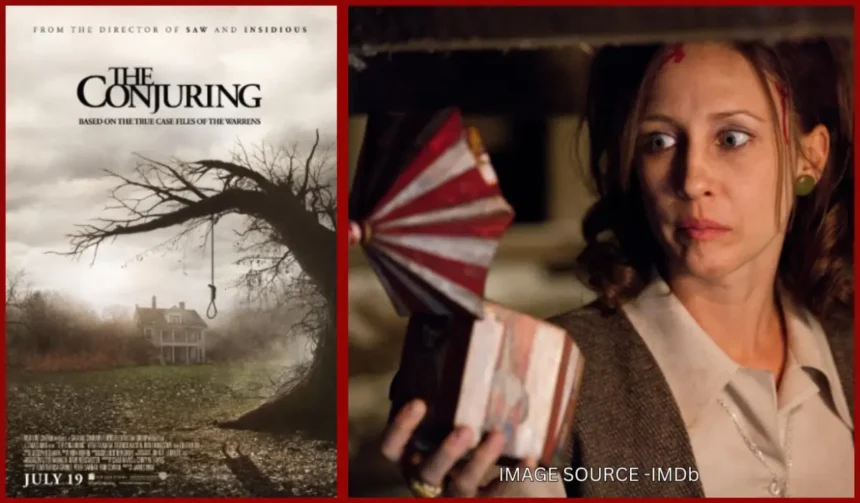
The Conjuring Movie Explained & Ending Explained
The Terrifying True Story That Launched a Universe
🗓️ Release Year
2013
📺 Streaming On
IMDb
7.5/10
Rotten Tomatoes
86%
Certified Fresh
1. The Conjuring (2013) Movie Explained & Ending Explained: The True Story Behind the Horror
Welcome to a definitive movie explained and ending explained guide for The Conjuring. This 2013 film isn’t just a jump-scare fest. It’s a meticulously crafted supernatural thriller based on the real-life case files of paranormal investigators Ed and Lorraine Warren.
Directed by James Wan, this movie redefined modern horror. It blends a chilling “based on a true story” premise with classic haunted house tropes. In this article, we’ll break down the entire plot, uncover its key themes, and provide a deep-dive into that intense, faith-testing finale.
If you’ve just finished the movie with questions, you’re in the right place. Let’s step back into the Perron family’s farmhouse and unravel the darkness within.
2. Overview
The Conjuring is a supernatural horror film that premiered in 2013. With a runtime of 112 minutes, it masterfully builds dread through atmosphere rather than pure gore. The mood is one of creeping, palpable terror, rooted in the vulnerability of family and home.
The film is often credited with reviving the haunted house subgenre. It leans heavily on character development and slow-burn tension. Its “true story” tagline, referencing the alleged experiences of the Perron family in the 1970s, adds a chilling layer of authenticity.
Themes of faith, motherhood, sacrifice, and the cyclical nature of evil are woven throughout. It’s a story about two families: one fighting to save their home, and the other fighting to save souls.
3. SPOILER WARNING
⚠️ FULL SPOILERS AHEAD ⚠️
This article contains a complete breakdown of *The Conjuring*’s plot, including major twists and a detailed analysis of the ending. Proceed only if you’ve seen the film.
4. Story Explained (Full Breakdown)
Act 1 Explained: A New Home, An Old Evil
The movie opens not with the Perrons, but with paranormal investigators Ed and Lorraine Warren (Patrick Wilson and Vera Farmiga). They are concluding the infamous Annabelle case, establishing their credentials and the very real dangers they face. This prologue sets the tone: evil is tangible and objects can be haunted.
We then meet the Perron family. Roger and Carolyn, along with their five daughters, move into a secluded old farmhouse in Harrisville, Rhode Island. The initial signs are subtle. The family dog refuses to enter the house. Clocks stop at exactly 3:07 AM. A strange, pungent smell appears in certain rooms.
Carolyn begins to find unexplained bruises on her body. The children experience sleep paralysis and report being tugged by an invisible force. The haunting escalates from unsettling noises to violent encounters, most terrifyingly targeting the youngest daughters.
Act 2 Explained: The Investigation Deepens
Desperate, Carolyn seeks out the Warrens. Lorraine, a gifted clairvoyant, immediately senses a oppressive, malicious presence in the house. She perceives the traumatic history of the land—a site of witchcraft, murder, and despair.
The Warrens bring in a team, including a police officer and a photographer, to document the phenomena. Their investigation reveals the house’s dark past. In the 19th century, a woman named Bathsheba Sherman, who believed herself a witch and dedicated her child to the devil, hanged herself on the property after cursing all who would take her land.
Lorraine discovers that Bathsheba’s primary goal is to possess mothers and compel them to kill their children. She targets Carolyn, creating a rift between her and Roger. The paranormal activity becomes a full-scale assault, culminating in Carolyn being violently thrown across the basement.
Act 3 Explained: The Exorcism
With the church’s reluctant permission (as the entity is not yet possessing a person, but the house and latching onto Carolyn), Ed prepares for a rare in-home exorcism. The family is sent away, but Bathsheba’s spirit tricks Carolyn into returning, isolating her for the final battle.
During the exorcism, the entity fully manifests, using Carolyn’s body to attack Ed and Lorraine. It taunts Lorraine with visions of her own daughter and the tragic death she foresaw for Ed. The climax is a test of faith and love. Ed, nearly strangled, reminds Carolyn of a happy memory with her children—a “latchkey” moment of pure love.
This appeal to maternal love breaks Bathsheba’s hold just long enough for Lorraine to complete the rite, commanding the spirit to return to hell. The entity is vanquished, and Carolyn is freed.

5. Key Themes Explained
Faith vs. Empirical Evidence: The Warrens represent a blend of spiritual faith and investigative methodology. The movie posits that some evils can only be understood and fought on a spiritual plane, beyond physical proof.
The Sanctity of Family and Home: The haunted house genre exploits the violation of our safest space. Bathsheba’s evil specifically attacks the mother-child bond, the core of the family unit. The victory is achieved not by violence, but by reinforcing that bond.
The Cyclical Nature of Evil and Trauma: The land is a prison for trauma. Bathsheba repeats her cycle of murderous motherhood through her victims. The film suggests evil is a historical stain that must be consciously broken.
Motherhood as Strength and Vulnerability: Both Carolyn and Lorraine are mothers. Their maternal instincts are their greatest strength (protecting children) and their point of greatest vulnerability (targeted by Bathsheba).
6. Characters Explained
Ed Warren (Patrick Wilson): The demonologist and practicing Catholic. He is the physical anchor and the ritualist. His role is to provide the structure of faith (prayer, exorcism rite) to combat the chaos of evil.
Lorraine Warren (Vera Farmiga): The clairvoyant. She is the emotional and intuitive heart of the duo. Her gift is a burden that exposes her to the full horror of the supernatural, but it is also the key to understanding the enemy.
Carolyn Perron (Lili Taylor): The heart of the victim family. Her love for her children makes her a target. Her arc is one of gradual erosion by fear, followed by reclamation through love.
Bathsheba Sherman: The ancient antagonist. She is not a ghost seeking peace, but a demonic spirit perpetuating a cycle of hatred and perversion of motherhood. She represents pure, historical malice.
7. Twist Explained
The film’s central “twist” is the reveal of Bathsheba’s true motive and modus operandi. Initially, the haunting seems random and chaotic. The investigation reveals it is a targeted, cyclical campaign.
Bathsheba doesn’t just want to scare the Perrons away. She wants to corrupt Carolyn, make her kill her own children, and claim their souls. This transforms the story from a simple ghost tale into a battle for a mother’s soul.
Furthermore, the twist that the entity was never fully possessing Carolyn until the end is crucial. It was oppressing her, weakening her will, making the final exorcism a race against total possession.

8. Movie Ending Explained
What Exactly Happens?
After the successful exorcism, the Perron family returns to a peaceful home. In the final scene, the Warrens are back in their artifact room. They place the music box from the Perron house on a shelf, acknowledging it is still lightly haunted but contained.
As they leave the room, the camera lingers on the various haunted objects. It then slowly pushes in on the creepy Annabelle doll. Its eyes seem to follow the camera, and it gives a slight, sinister tilt of its head. The screen cuts to black.
What The Ending Means
The ending serves two masterful purposes. First, it provides closure for the Perron case—the family is saved, the house is cleansed. The music box’s residual energy shows that while the major evil is gone, traces remain, reflecting real-life paranormal beliefs.
Second, and more importantly, the focus on Annabelle is a brilliant sequel hook and a thematic statement. It signifies that the battle is never over. Evil is not eradicated; it is merely stored, contained, and waiting. The Warrens’ work is a continuous, exhausting vocation.
How It Connects to the Theme
The ending reinforces the theme of an ongoing war between good and evil. The Warrens’ home is not a sanctuary; it’s a prison for evil. Their life is one of constant vigilance. The final shot asks: Can evil ever truly be defeated, or only managed?
Alternate Interpretations
Some view the ending as a cynical note: the Warrens are, perhaps unintentionally, collectors of evil, concentrating it in one place. The tilt of Annabelle’s head could be read as a knowing wink—the demon is aware it’s part of a larger collection, a museum of the damned.
Director’s Intention
James Wan has stated he wanted the ending to feel like a chapter closing, but within a much larger, ongoing book. It roots the film in the wider “Warrenverse,” suggesting that every case is connected to a vast, hidden world of supernatural terror.

9. Performances
Vera Farmiga is the film’s soul. She portrays Lorraine’s profound empathy and psychic trauma with a graceful vulnerability. You feel the weight of every vision she endures. Her strength is quiet but unbreakable.
Patrick Wilson provides the necessary grounded stability. His Ed Warren is a man of deep, practical faith. Wilson avoids caricature, making Ed’s belief system feel like a scientist’s conviction rather than blind zealotry.
Lili Taylor’s transformation is harrowing. She moves from warm, 70s mom to a gaunt, terrorized vessel with terrifying believability. Her physical commitment sells the horror of bodily violation.
The child actors, particularly Joey King as Christine, are remarkably effective. Their fear feels genuine, never performative, which exponentially increases the film’s terror.
10. Direction & Visuals
James Wan’s direction is a masterclass in suspense. He uses wide shots of empty, darkening corridors to build dread. His signature “quiet, quiet, BANG!” scares are perfectly timed, but the true horror lies in the lingering stillness.
The cinematography employs a de-saturated, 70s film stock palette, grounding it in period authenticity. The camera often moves with an unseen, prowling intelligence, mimicking the entity’s perspective.
Brilliant visual motifs include the use of darkness as a physical entity and reflections that reveal hidden figures. The set design of the farmhouse is cluttered and lived-in, making the unnatural intrusions starkly visible.
11. Pros and Cons
Pros:
- Unmatched atmosphere and tension-building.
- Superb, character-driven performances, especially from Vera Farmiga.
- Intelligent script that prioritizes story over cheap scares.
- “Based on a true story” framework is used effectively to heighten fear.
- Established a rich mythology for a sprawling franchise.
Cons:
- Adheres closely to familiar haunted house tropes.
- The historical backstory of Bathsheba, while creepy, is delivered via exposition.
- The ultimate resolution relies on a familiar exorcism climax.
- Purists may debate the artistic license taken with the “true” story.
12. Cast
| Actor/Actress | Character | Role Description |
|---|---|---|
| Vera Farmiga | Lorraine Warren | Clairvoyant paranormal investigator. |
| Patrick Wilson | Ed Warren | Demonologist and Lorraine’s husband. |
| Lili Taylor | Carolyn Perron | Matriarch of the haunted Perron family. |
| Ron Livingston | Roger Perron | Carolyn’s husband, initially skeptical. |
| Joey King | Christine Perron | One of the Perron daughters, first to see the spirit. |
| Shanley Caswell | Andrea Perron | The eldest Perron daughter. |
| Hayley McFarland | Nancy Perron | Another Perron daughter. |
| Mackenzie Foy | Cindy Perron | The youngest Perron daughter. |
| Kyla Deaver | April Perron | A Perron daughter. |
| Sterling Jerins | Judy Warren | Ed and Lorraine’s young daughter. |
13. Crew
| Role | Name | Notable Contribution |
|---|---|---|
| Director | James Wan | Orchestrated the film’s tone, scares, and visual style. |
| Screenplay | Chad Hayes & Carey W. Hayes | Wrote the script based on the Warrens’ case files. |
| Cinematographer | John R. Leonetti | Created the film’s atmospheric, period-appropriate look. |
| Composer | Joseph Bishara | Wrote the chilling, string-heavy score (also played Bathsheba). |
| Editor | Kirk M. Morri | Crafted the film’s precise, tension-building pace. |
| Production Designer | Julie Berghoff | Designed the iconic Perron farmhouse and Warren artifact room. |
14. Who Should Watch?
- Fans of classic, atmospheric horror over slasher gore.
- Viewers intrigued by the “based on a true story” paranormal genre.
- Anyone who enjoys slow-burn tension and well-developed characters.
- Moviegoers looking for the origins of a major modern horror universe.
Avoid if you are highly sensitive to themes of possession, child endangerment, or jump scares.
15. Verdict
The Conjuring is a modern horror classic for a reason. It succeeds not through novelty, but through impeccable execution. The direction is taut, the performances are stellar, and the scares are earned through genuine investment in the Perron family’s plight.
Its greatest achievement is making faith and love the ultimate weapons against a palpable, ancient evil. While it kickstarted a massive franchise, the original remains the most potent and focused. It’s a masterfully crafted haunted house story that continues to terrify, precisely because it makes you care before it makes you scream.
16. Reviews & Rankings
| Source | Score | Verdict Snippet |
|---|---|---|
| IMDb User Score | 7.5/10 | “A return to classic, character-driven horror.” |
| Rotten Tomatoes (Critics) | 86% | “Strikingly old-fashioned, The Conjuring builds spine-tingling tension.” |
| Metacritic | 68/100 | “Generally favorable reviews based on its effective craft.” |
| Common Sense Media | 4/5 | “Intense, disturbing horror for mature teens and up.” |
| Empire Magazine | 4/5 | “Wan conducts the fear with a veteran’s flair.” |
17. Where to Watch
As of the latest update, The Conjuring (2013) is available for streaming on Netflix in several regions. It is also available for digital rental/purchase on platforms like Amazon Prime Video, Apple TV, and Google Play.
Watch it on Netflix for a direct dive into the beginning of the Conjuring Universe.


