
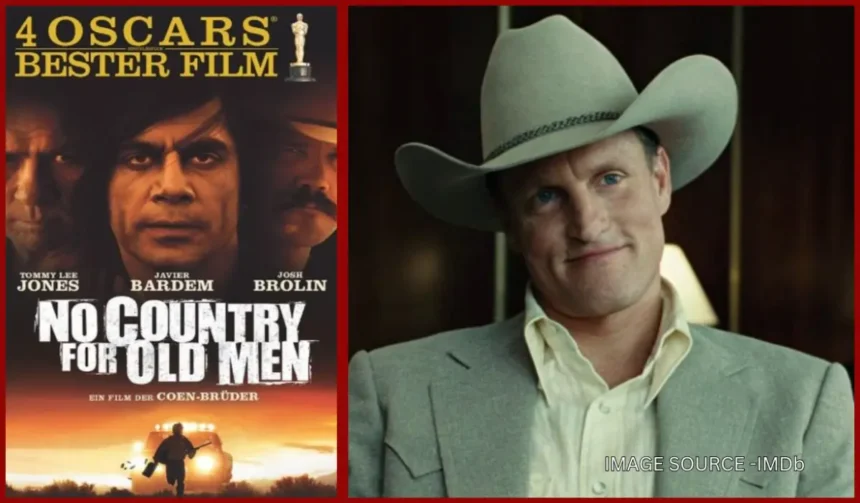
No Country for Old Men
A Descent into Unforgiving Fate
🗓️ Release Year
2007
📺 Streaming On
Netflix, Prime Video
IMDb
8.2/10
Rotten Tomatoes
93%
Certified Fresh
1. No Country for Old Men Movie Explained: Breaking Down the Coen Brothers’ Masterpiece
The Coen Brothers’ No Country for Old Men is not a typical thriller. It is a bleak, philosophical meditation on fate, chaos, and the evolving nature of evil. This movie explained guide will walk you through its complex narrative.
We’ll break down the plot, characters, and the film’s stark themes. Most importantly, we will provide a deep dive into the No Country for Old Men ending explained, decoding one of cinema’s most ambiguous and discussed finales.
If you found the film mesmerizing but perplexing, you’re not alone. This article serves as your definitive explainer.
2. Overview
Based on Cormac McCarthy’s novel, No Country for Old Men (2007) is a neo-Western crime thriller. It unfolds in the stark Texas desert in 1980. The film’s mood is one of relentless tension and existential dread.
With a runtime of 122 minutes, it is a masterclass in minimalist storytelling. The director duo, Joel and Ethan Coen, strip away musical scores and dramatic flair. They let silence, landscape, and moral ambiguity do the talking.
The result is a Best Picture winner that feels less like a chase film and more like a haunting sermon on a world losing its moral compass.
3. SPOILER WARNING
4. Story Explained (Full Breakdown)
Act 1 Explained: The Find and The Hunt
Llewelyn Moss (Josh Brolin), a welder, is hunting antelope when he stumbles upon the aftermath of a drug deal gone wrong. He finds dead men, heroin, and a suitcase containing $2.4 million. Moss takes the money, setting a catastrophic chain of events in motion.
That night, guilt leads him back to the scene with water for a dying man. He is spotted by a pursuing party, leading to a violent chase. The movie establishes Moss as resourceful but tragically out of his depth. Meanwhile, the psychopathic mercenary Anton Chigurh is hired to recover the money.
Chigurh represents an unstoppable force of nature. He kills a deputy with his own handcuffs and uses a captive bolt pistol (a cattle gun) as his signature weapon. Sheriff Ed Tom Bell (Tommy Lee Jones) investigates the massacre, sensing a new, unfathomable kind of evil.
Act 2 Explained: The Relentless Pursuit
The film becomes a tense cat-and-mouse game across West Texas. Moss sends his wife, Carla Jean, away for safety and attempts to outmaneuver Chigurh. He even retrieves the money from the air vent of a motel room just moments before Chigurh arrives.
In a famous scene, Chigurh forces a gas station proprietor to call a coin toss for his life. This isn’t random cruelty. It’s Chigurh presenting his worldview: life is a matter of arbitrary chance, and he is the agent of that chance. Moss meets Carson Wells, a rival hitman who explains Chigurh’s principles but is soon murdered by him.
Sheriff Bell is always a step behind, piecing together the horror through the carnage left in Chigurh’s wake. The OTT experience heightens this tension, as the silence and wide shots make every scene feel unbearably intimate.
Act 3 Explained: The Subversion
In a shocking narrative turn, Moss is killed off-screen. We learn of his death from a passing boys’ gang and later see Chigurh retrieving the money from his corpse. The presumed protagonist is removed abruptly, reinforcing the film’s core message: there are no heroes, only victims and instruments of fate.
Chigurh, wounded from a chaotic shootout, tends to his own injuries. He then visits Carla Jean, offering her the same coin toss her husband once refused. She rejects the premise, stating, “The coin don’t have no say. It’s just you.” He kills her anyway. Later, while driving away, he is severely injured in a random car accident—a victim of the very chance he worships.

5. Key Themes Explained
Fate vs. Free Will: This is the film’s central puzzle. Chigurh sees himself as a divine arbiter of fate, using the coin to decide who lives or dies. Moss believes in his own agency but is crushed by forces beyond his control. Sheriff Bell feels powerless against the rising tide.
The Evolution of Evil: Bell, an old-school lawman, constantly reflects on how the violence he sees is senseless and new. Chigurh isn’t a criminal with motives; he’s a force of anarchic, principled evil. The world has become a place where his kind of chaos can thrive.
The Death of the Old West: The title, from a Yeats poem, speaks to Bell’s feeling of obsolescence. The code of the West, where sheriffs could protect their people, is dead. The new “country” is lawless, random, and unforgiving.
6. Characters Explained
Llewelyn Moss: He is competent, brave, and cunning. His fatal flaw is the belief that he can outsmart the system and keep the money. His arc is a classic tragedy—a decent man felled by one greedy decision and the unstoppable consequence it summons.
Anton Chigurh: More a phenomenon than a man. He operates on a strict, internal code he calls “principles.” He is the embodiment of amoral, deterministic chaos. His strange haircut, calm demeanor, and unwavering eyes make him one of cinema’s most terrifying villains.
Sheriff Ed Tom Bell: The heart and moral center of the film. He is a good man rendered passive and disillusioned. His journey is not of action, but of reflection and retreat. He represents the audience, trying and failing to make sense of the senseless.

7. Twist Explained
The film’s major twist is the abrupt, off-screen death of Llewelyn Moss. In a conventional thriller, Moss would have a final showdown with Chigurh. Instead, the Coen Brothers deny us that catharsis.
This narrative choice is the entire point. Life isn’t a movie with neat confrontations. Evil often wins without ceremony. The real story isn’t the chase; it’s the aftermath and what it does to the soul of those who witness it, like Sheriff Bell.
8. Movie Ending Explained
The ending explained section is crucial for understanding this film’s profound ambiguity. Sheriff Bell visits his elderly uncle Ellis, a retired lawman. Ellis deflates Bell’s nostalgia, telling him the violence isn’t new—Bell just never saw it coming before. This shatters Bell’s worldview.
Bell then recounts two dreams to his wife. In the first, he lost some money his father had given him. This speaks to his feeling of failure, of losing the moral currency passed down to him.
The Second Dream – The Final Image:
In the second dream, he was riding horseback through cold mountain passes with his father. His father, riding ahead, carried fire in a horn “to get a light going.” Bell knew that in the dream, his father would fix a fire for them in the dark and cold. Then he woke up.
What It Means:
This dream is not bleak. It’s melancholic but comforting. Bell’s father represents the previous generation, the carriers of light and warmth (morality, purpose) in a dark world. Bell feels he has failed to carry that fire forward.
But the dream suggests he still believes the fire exists. His father is ahead of him, waiting in the afterlife (“that country”), to provide light and warmth again. Bell’s retirement is an admission of defeat in this world, but the dream hints at a spiritual hope, a reconciliation in death.
Chigurh’s random accident shows that even he is subject to chaos. His limp away symbolizes that his “principles” offer no ultimate protection.
9. Performances
The actor ensemble delivers career-defining work. Josh Brolin makes Moss ruggedly sympathetic and stubborn. Tommy Lee Jones, as Sheriff Bell, delivers a performance etched in weary sorrow. His monologues are not exposition, but poetry of regret.
The performance of Javier Bardem as Anton Chigurh is iconic. He doesn’t play a villain; he embodies an idea. His calm, polite menace is far more terrifying than any rage. He won the Oscar for Best Supporting Actor for creating a modern myth of evil.
10. Direction & Visuals
The director team, the Coen Brothers, and cinematographer Roger Deakins create a visual masterpiece. The Texas landscape is a character—vast, empty, and indifferent. The color palette is dusty and desaturated, reflecting the moral barrenness.
The Coens use long, static shots and agonizing silences to build unbearable tension. The absence of a musical score forces you to sit in the dreadful reality of each moment. Key scenes are masterclasses in visual storytelling, like the shadows under the motel door showing Chigurh’s arrival.
11. Pros and Cons
Pros:
- A taut, intellectually stimulating screenplay that respects the audience’s intelligence.
- Landmark performances, especially from Bardem.
- Unmatched atmospheric direction and cinematography.
- A bold, anti-formulaic narrative structure that serves its themes.
Cons:
- The deliberate pace and lack of score may frustrate some viewers.
- The abrupt, anti-climactic resolution can feel unsatisfying if you miss its thematic purpose.
- A deeply pessimistic worldview that offers little traditional hope.
12. Cast
| Actor/Actress Name | Character Portrayed | Notes |
|---|---|---|
| Tommy Lee Jones | Sheriff Ed Tom Bell | The moral anchor, delivers a haunting, introspective performance. |
| Javier Bardem | Anton Chigurh | Oscar-winning role. Creates one of cinema’s greatest antagonists. |
| Josh Brolin | Llewelyn Moss | Brings grit and tragic humanity to the “everyman” role. |
| Kelly Macdonald | Carla Jean Moss | Her final scene with Chigurh is a heartbreaking stand against his philosophy. |
| Woody Harrelson | Carson Wells | Provides exposition and a foil for Chigurh, despite limited screen time. |
13. Crew
| Role | Name | Contribution |
|---|---|---|
| Directors | Joel Coen & Ethan Coen | Masters of tone, adapted McCarthy’s novel with faithful precision. |
| Cinematographer | Roger Deakins | Crafted the film’s iconic, sun-bleached, and shadowy visual language. |
| Screenwriters | Joel & Ethan Coen | Faithfully adapted the novel, preserving its philosophical dialogue. |
| Editor | Roderick Jaynes | (A pseudonym for the Coens). Pacing is meticulous and deliberate. |
| Producer | Scott Rudin, et al. | Assembled the perfect team for this demanding project. |
14. Who Should Watch?
Fans of cerebral thrillers and neo-Westerns will find a masterpiece. If you appreciate films that prioritize theme and character over plot convenience, this is essential viewing. It’s perfect for OTT platforms where you can pause and reflect.
Avoid if you seek action-packed closure or a traditionally heroic narrative. This is a film for the patient and the contemplative.
15. Verdict
No Country for Old Men is a flawless, chilling exploration of a world governed by chance and cruelty. It subverts every expectation of its genre to deliver a profound statement on evil and obsolescence.
The No Country for Old Men ending explained not as a mystery but as a somber meditation provides the key to the entire film. It confirms this is not just a crime story, but a timeless, tragic parable about the light fading from the world, and those left behind to remember it.
16. Reviews & Rankings
| Source | Score | Verdict |
|---|---|---|
| IMDb | 8.2/10 | “A stark and gripping masterpiece of suspense.” |
| Rotten Tomatoes | 93% | “Certified Fresh. A potent meditation on mortality and fate.” |
| Metacritic | 91/100 | “Universal Acclaim.” |
| Academy Awards | 4 Wins | Won Best Picture, Director, Supporting Actor (Bardem), Adapted Screenplay. |
17. Where to Watch
You can stream this cinematic classic and unpack its layers for yourself. Watch “No Country for Old Men” on Netflix and Amazon Prime Video.


