
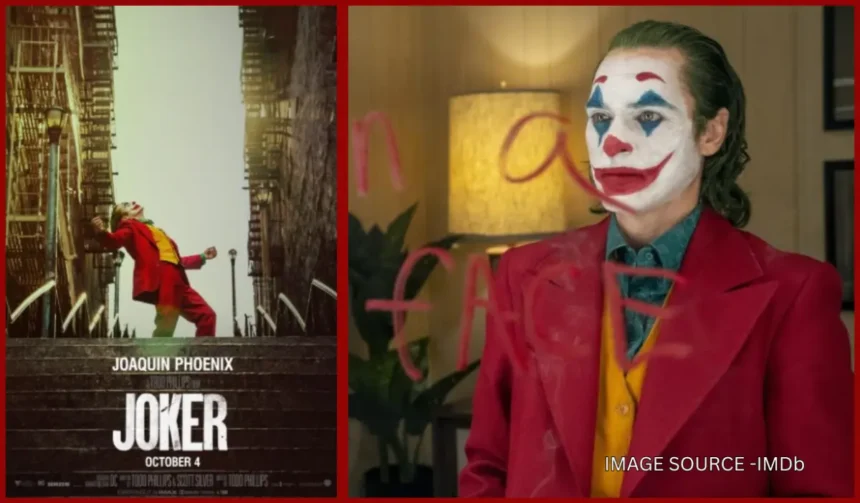
Joker (2019): Ending Explained
A Descent into Madness – Full Movie Breakdown & Analysis
🗓️ Release Year
2019
📺 Streaming On
HBO Max
IMDb
8.4/10
Rotten Tomatoes
68% Critics
88% Audience Score
1. Ending Explained: The Final Scene of Joker and What It Really Means
Todd Phillips’ Joker is not a superhero movie. It’s a chilling, character-driven psychological thriller that asks a terrifying question: what happens when society abandons its most vulnerable? This movie explained guide will walk you through the harrowing journey of Arthur Fleck.
We will break down the plot act by act, explore its dense themes, and provide a clear ending explained analysis. This film, anchored by Joaquin Phoenix’s Oscar-winning performance, is a masterclass in tension. It blends gritty realism with unreliable narration.
Our breakdown will help you understand not just what happens, but why it happens. We’ll explore the symbolism, the debated twists, and the final, bloody birth of the Joker.
2. Overview
Joker (2019) is a standalone psychological drama. It wears the skin of a comic book origin story but functions as a Scorsese-esque character study. The mood is relentlessly grim, steeped in the grime and despair of early-1980s Gotham City.
The film’s genre is a blend of tragedy and horror. It has a runtime of 2 hours and 2 minutes. The pacing is deliberate, building an almost unbearable sense of dread. The tone is established through a muted, sickly color palette and a haunting, cello-heavy score.
Themes of societal neglect, mental illness, and the nature of identity are central. It’s a film designed to provoke discomfort and discussion long after the credits roll.
⚠️ SPOILER WARNING
This article contains full spoilers for Joker (2019). Key plot points, twists, and the ending are discussed in detail ahead.
3. Story Explained (Full Breakdown)
Act 1 Explained: The Breaking Point
Arthur Fleck is introduced as a profoundly isolated man. He works as a clown-for-hire in a decaying Gotham. He cares for his ailing mother, Penny, and suffers from a condition that causes inappropriate, uncontrollable laughter. His dream is to be a stand-up comedian.
The world is actively hostile to him. He is attacked by teenagers, dismissed by his social worker, and mocked by everyone. He idolizes talk show host Murray Franklin, fantasizing about a paternal connection. The first act shows a man clinging to fraying ropes of routine and hope.
A co-worker gives him a gun for protection. This act of false kindness sets tragedy in motion. Arthur’s grip on reality is already tenuous, and the weapon becomes a darkly empowering object.
Act 2 Explained: The Unraveling
After accidentally firing the gun at a children’s hospital, Arthur is fired. On the subway, still in clown makeup, he is brutally beaten by three drunk Wall Street bankers. In a moment of panicked retaliation, he shoots all three dead.
The “Kill the Rich” subway murders unintentionally spark a city-wide anti-elite movement. Masked clowns become a symbol of protest. Arthur watches this chaos unfold, initially in fear, then with a dawning sense of purpose.
He discovers hidden letters from his mother to Thomas Wayne. They suggest he is Thomas Wayne’s illegitimate son. This sends Arthur on a desperate quest for identity and belonging, culminating in a humiliating confrontation with a dismissive Thomas Wayne.
Act 3 Explained: The Transformation
Arthur’s world completely shatters. At Arkham State Hospital, he learns the truth from Thomas Wayne’s file: he was adopted. His mother was delusional and allowed her abusive boyfriend to severely neglect and injure young Arthur. His entire life narrative—his name, his lineage, his trauma—was a lie.
This is the final break. He suffocates his mother in her hospital bed. He then murders his former colleague, Randall, who betrayed him. Arthur is invited onto the Murray Franklin Live show. He plans to kill himself on live TV.
Instead, he delivers a searing monologue. He confesses to the subway murders and indicts Murray and society for their cruelty. In front of millions, he shoots Murray Franklin dead. The act of planned suicide becomes a very public murder.

4. Key Themes Explained
Society Creates Its Own Monsters: This is the film’s core argument. Every system that should support Arthur—healthcare, social services, employment—fails him. The wealthy, like Thomas Wayne, view the poor as “clowns.” The film suggests the Joker is not an anomaly, but a direct product of societal neglect.
The Line Between Tragedy and Comedy: Arthur’s pathological laughter reframes suffering as a joke. The film itself is structured like a bad stand-up routine, with Arthur’s life as the punchline. His transformation is about seizing control of the narrative, turning his pain into a performance.
Reality vs. Fantasy: Much of the film is filtered through Arthur’s broken psyche. Key scenes, like his relationship with neighbor Sophie, are revealed to be elaborate fantasies. This forces the viewer to question what is real, mirroring Arthur’s own dissociation from the world.
The Search for Identity: Arthur spends the film seeking validation—from his mother, from Murray, from Thomas Wayne. His violent rebirth as the Joker occurs only when he rejects all external sources of identity. He decides his own meaning: “I used to think my life was a tragedy, but now I realize, it’s a comedy.”
5. Characters Explained
Arthur Fleck/Joker: A man defined by absence—of love, care, and truth. His journey is from passive victim to active agent of chaos. His laughter is a physical symptom of his psychological pain. His transformation is not about becoming evil, but about surrendering to the chaos he’s always felt inside.
Penny Fleck: Represents the foundational lie of Arthur’s life. Her delusions and abuse created Arthur’s trauma. Her fantasy of a connection to the Waynes is a desperate escape from her own grim reality, which she imposed on her son.
Murray Franklin: The smiling face of a cruel system. He represents the public who mock weakness for entertainment. To Arthur, he shifts from a father figure to the ultimate symbol of betrayal, using Arthur’s pain for cheap laughs on national TV.
Thomas Wayne: The embodiment of the ruling elite’s hypocrisy. He campaigns to “save Gotham” while showing utter contempt for its struggling citizens. He represents the paternal rejection that finally pushes Arthur over the edge.
6. Twist Explained
The film’s central twist is that Arthur’s relationship with his single mother neighbor, Sophie Dumond, was entirely a fantasy.
Throughout the film, we see tender moments: dates, her attending his stand-up, her supporting him. After Arthur’s arrest, the film reveals Sophie is a stranger. She is terrified of him when he enters her apartment.
This twist is crucial. It shows the depth of Arthur’s loneliness and dissociation. It confirms the film’s unreliability. It also underscores his tragedy—every moment of human connection we witnessed was a desperate fiction constructed in his mind.

7. Movie Ending Explained
The ending explained for Joker is layered and deliberately ambiguous.
What Happens: After killing Murray Franklin, Arthur sparks a city-wide riot. Followers in clown masks rescue him from a police car. In the chaos, Thomas Wayne and his wife are murdered in an alley (the canonical origin of Batman). Arthur stands atop a police car, dancing in ecstasy as the city burns. The final scene shows him in Arkham Asylum, telling a joke to his therapist. He laughs, then stops, stating she “wouldn’t get it.” He leaves bloody footprints as he dances down the hallway, chased by orderlies.
What the Ending Means: The riot is the logical conclusion of the film’s theme. Arthur’s personal madness has given voice to the city’s collective rage. He didn’t start the movement, but he became its icon. The Joker is no longer just a man; he is an idea, a symbol of anarchic rebellion.
The Arkham scene is the key to interpretation. Is this reality? Or is it another of Arthur’s fantasies, a story he’s telling himself? The bloody footprints suggest the preceding events were real. His final, calm demeanor shows he has fully integrated his new identity. The chaotic, joyful dance is his true self, finally unleashed.
Director’s Intention: Todd Phillips leaves it open-ended. The ending suggests that the “real” story is irrelevant. What matters is the myth. The film we watched could be the true origin, or it could be just one of many possible stories the Joker tells himself in his cell. This aligns with the comic book mythology of the character having multiple, contradictory origins.
8. Performances
Joaquin Phoenix delivers a physically and psychologically punishing performance. His emaciated frame and the contorted, rib-cracking laughter are visceral. He doesn’t play a villain; he plays a wounded animal decaying from the inside out. The transformation is in his eyes—the flicker of hope in the first act is completely extinguished by the finale, replaced by a terrifying, serene emptiness.
Robert De Niro, as Murray Franklin, provides a perfect foil. He is all slick, condescending charm. His performance is a deliberate callback to his role in The King of Comedy, reinforcing the film’s themes of obsession and fame.
Frances Conroy as Penny Fleck is haunting. She portrays a woman lost in fragile delusion, her love for Arthur poisoned by her own mental illness and past sins. The supporting cast, including Zazie Beetz as Sophie, effectively serves the claustrophobic, subjective reality of Arthur’s world.
9. Direction & Visuals
Todd Phillips and cinematographer Lawrence Sher craft a visual language of decay. Gotham is a character—filthy, overcrowded, and vibrating with suppressed rage. The color palette is dominated by sickly greens, muted yellows, and oppressive greys, with Arthur’s vibrant red clown suit acting as a shocking beacon of violence.
The camera often follows Arthur closely, trapping the audience in his perspective. The use of slow, mournful dance sequences provides unsettling moments of release amidst the tension. The score by Hildur Guðnadóttir is a character in itself—a groaning, cello-driven lament that embodies Arthur’s inner turmoil.
Visual symbolism is key: the long, winding stairs represent Arthur’s arduous climb through life. His final dance down them signifies his descent into chaos, which he now embraces as freedom.
10. Pros and Cons
Pros:
- Joaquin Phoenix’s landmark, all-consuming performance.
- A bold, uncompromising vision that treats its subject with serious artistic intent.
- Stunning, evocative cinematography and a powerful, Oscar-winning score.
- Provokes genuine, necessary discussion about mental health and societal divides.
Cons:
- The bleak tone can feel unrelenting and emotionally exhausting.
- The social commentary, while potent, is sometimes delivered with a heavy hand.
- The homage to Scorsese films (especially Taxi Driver and The King of Comedy) is so pronounced it occasionally borders on derivative for some viewers.
11. Cast
| Actor | Character | Role Description |
|---|---|---|
| Joaquin Phoenix | Arthur Fleck / Joker | A mentally ill, aspiring comedian whose failures lead to a violent new identity. |
| Robert De Niro | Murray Franklin | A famous late-night talk show host who publicly mocks Arthur. |
| Zazie Beetz | Sophie Dumond | Arthur’s neighbor, who becomes the subject of his elaborate fantasy. |
| Frances Conroy | Penny Fleck | Arthur’s sickly, delusional mother, who hides a dark secret. |
| Brett Cullen | Thomas Wayne | A wealthy mayoral candidate and philanthropist with a harsh view of Gotham’s poor. |
12. Crew
| Role | Name | Notable Contribution |
|---|---|---|
| Director | Todd Phillips | Shifted from comedy to helm this gritty psychological drama. |
| Screenwriters | Todd Phillips & Scott Silver | Crafted the origin story focusing on mental illness and societal decay. |
| Cinematographer | Lawrence Sher | Created the film’s iconic, grimy look and distinct color palette. |
| Composer | Hildur Guðnadóttir | Wrote the haunting, cello-based score that won an Academy Award. |
| Production Designer | Mark Friedberg | Built the sprawling, decaying 1981 Gotham City sets. |
13. Who Should Watch?
This film is for viewers who appreciate intense character studies and psychological horror. It’s essential for fans of cinematic artistry and complex performances.
It is NOT for those seeking a traditional, action-packed comic book movie. It’s also a very difficult watch for anyone sensitive to depictions of violence, mental health crises, and bleak societal commentary.
14. Verdict
Joker is a cinematic lightning rod—a brutal, challenging, and masterfully crafted tragedy. It succeeds not as a comic book film, but as a stark portrait of a man disintegrating under the weight of a cruel world.
While its themes are debatable, its power is undeniable. Joaquin Phoenix’s performance is one for the ages, and the film’s visual and auditory craft is impeccable. It’s a movie that demands to be grappled with, haunting the viewer long after it ends.
15. Reviews & Rankings
| Source | Rating | Verdict Snippet |
|---|---|---|
| IMDb User Score | 8.4/10 | “A disturbing masterpiece of modern cinema.” |
| Rotten Tomatoes (Critics) | 68% | “A bleak, shockingly violent origin story that is as uncomfortable as it is compelling.” |
| Rotten Tomatoes (Audience) | 88% | “Joaquin Phoenix is phenomenal. A movie that sticks with you.” |
| Metacritic | 59/100 | “Mixed or average reviews based on its controversial themes.” |
16. Where to Watch
Joker (2019) is available to stream in the United States on HBO Max. It is also available for digital rental or purchase on platforms like Amazon Prime Video, Apple TV, and Google Play.


