
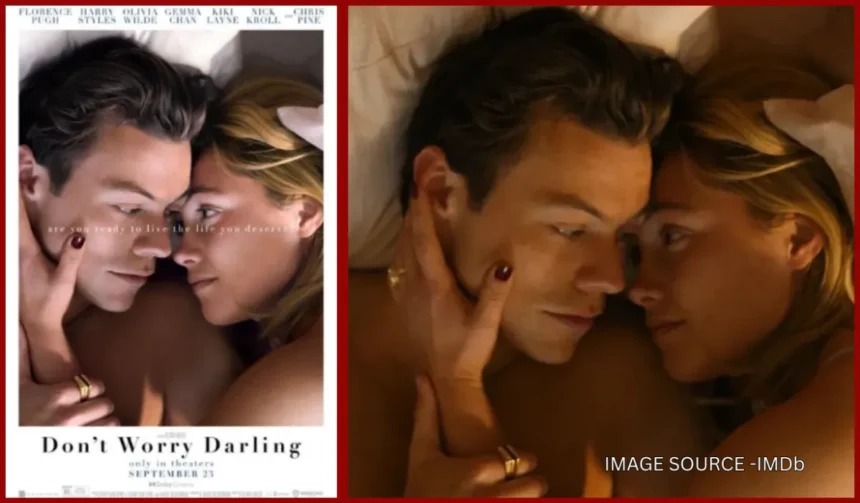
Don’t Worry Darling: Movie Explained + Ending Explained
A Psychological Thriller Trapped in a Perfect Illusion
🗓️ Release Year
2022
📺 Streaming On
HBO Max / Prime Video
IMDb
6.2/10
Rotten Tomatoes
38%
1. Don’t Worry Darling Ending Explained: What Happened to Alice & Jack?
Don’t Worry Darling is a stylish, unsettling psychological thriller that plays like a beautiful, sinister dream. Directed by Olivia Wilde, the film plunges us into the picture-perfect 1950s community of Victory, where everything seems flawless on the surface. But as cracks begin to show, a terrifying truth emerges.
This article will provide a complete Movie Explained walkthrough, breaking down the plot act by act. We will then dive deep into the film’s complex finale with a detailed Ending Explained analysis. We’ll explore the symbolism, the shocking twist, and what director Olivia Wilde is ultimately saying about control, reality, and freedom.
2. Overview
Don’t Worry Darling (2022) is a dystopian psychological thriller with strong elements of science fiction and social horror. The film’s mood shifts from sun-drenched, mid-century optimism to a chilling, paranoid nightmare.
With a runtime of 122 minutes, it boasts a stunning visual aesthetic, a haunting score, and a central mystery that fuels its narrative engine. The movie explores themes of patriarchal control, the commodification of women, and the seductive danger of escaping reality.
3. SPOILER WARNING
4. Story Explained (Full Breakdown)
Act 1 Explained: The Perfect Life in Victory
We are introduced to Alice and Jack Chambers (Florence Pugh and Harry Styles), a young, glamorous couple living in the experimental company town of Victory in the 1950s. Jack works for the mysterious “Victory Project,” headed by the charismatic Frank (Chris Pine). Alice, like all the other wives, spends her days in domestic bliss—cleaning, shopping, and preparing for her husband’s return.
Their life is a cycle of cocktails, synchronized dance routines, and perfect dinners. The rules are simple: wives stay in town, husbands go to the secret desert headquarters to work on “progressive materials” that will change the world. The first cracks appear when Alice’s friend Margaret (KiKi Layne) begins acting erratically, claiming Victory isn’t real, before allegedly committing suicide.
Act 2 Explained: Cracks in the Facade
Alice’s reality starts to unravel. She experiences disturbing visions—a plane crashing, eggs that are hollow, herself smashing her face against glass. She sees Margaret pleading from a rooftop. During a party, she witnesses a synchronized “headache” among the wives.
Her growing suspicion and defiance put her at odds with Jack and the entire community. She tries to drive to the headquarters but hits an invisible, shimmering wall at the desert’s edge. Frank and his wife Shelley (Gemma Chan) gaslight her, suggesting she is unwell, like Margaret was. Jack, desperate to keep her in line, begins medicating her food.
Act 3 Explained: The Truth Uncovered
Alice’s rebellion culminates at a dramatic dinner party where she publicly confronts Frank. He delivers a chilling monologue about men providing and women being the “key” to it all. Alice, in a fit of rage, stabs him in the hand with a fork.
Declared a threat, she is taken to the “Victory Medical Center” for a brutal, forced lobotomy. At the last moment, Bunny (Olivia Wilde)—another wife who has silently understood the truth for years—helps Alice escape. Bunny reveals she stays for her children, who only exist in Victory. Alice hijacks one of the red planes from her visions and crashes it into the headquarters dome, shattering the simulation.
5. Key Themes Explained
The movie is a potent allegory for several interconnected ideas:
The Patriarchy as a Gilded Cage: Victory is a literal manifestation of a retrograde male fantasy. The men control the narrative, the economy, and the women’s bodies. The wives are decorative, docile accessories whose purpose is to validate the men’s success. Frank’s cult is built on this ideology.
Escape from a Disappointing Reality: The twist reveals this is not about time travel, but about escapism. The men in the simulation are, in reality, failures or dissatisfied individuals. They choose to imprison their partners in a fake world where they feel powerful and in control, rather than improving their real lives.
The Violence of Gaslighting: Alice’s journey is a textbook case of gaslighting. Her very real perceptions are dismissed as “sickness.” The community, medicine, and even her beloved husband are weaponized to make her doubt her own mind, a metaphor for systemic oppression.

6. Characters Explained
Alice (Florence Pugh): Our protagonist is intelligent, curious, and deeply sensual. Her arc is one of awakening and rebellion. Her “glitches” are her real self fighting against the programmed reality. She represents the unquenchable human spirit that refuses to be subdued.
Jack (Harry Styles): A complex antagonist motivated by profound insecurity and love warped into possession. In the real world, he is unemployed and addicted to Frank’s red-pill rhetoric. In Victory, he gets to be the provider, but his guilt over imprisoning Alice slowly eats away at him.
Frank (Chris Pine): The cult leader and architect of the Victory Project. He sells a philosophy of male supremacy and nostalgic traditionalism. He is a tech bro guru, using advanced simulation to create a world where his ideology reigns unchallenged.
Bunny (Olivia Wilde): The tragic realist. She knows the truth but has made a conscious, heartbreaking choice to remain in the simulation to be with the children she lost in the real world. She embodies the painful compromises people make.
7. Twist Explained
The central twist is that Victory is not a real 1950s town but a highly advanced virtual reality simulation.
The men are volunteers from the present day who have joined Frank’s cult-like “Victory Project.” They lie immobilized in their real-world apartments, wearing VR rigs, while their conscious minds—and the kidnapped consciousnesses of their wives/girlfriends—inhabit the simulation. The headquarters is the server hub. The red planes are intrusion detection systems. The “glitches” (like the egg) are rendering errors or memory leaks.
This twist recontextualizes the entire film. It’s not a period piece but a sci-fi story about modern-day misogyny using technology to create the ultimate retro prison.
8. Movie Ending Explained
What Exactly Happens?
After crashing the plane into the dome, Alice’s real-world body awakens in a sparse, modern apartment. She is weak, attached to IV lines and the VR equipment. She pulls the plugs and stumbles out of bed. Across the room, she sees Jack’s real body in his rig. He is also waking up.
He pleads with her, saying he did it all because he loved her and their real life was a mess. In a moment of raw fury and liberation, Alice chooses not to comfort him. She walks out of the apartment, into the bleak, real-world hallway, and leans against the wall, sobbing—but she is free. The final shot holds on her face, a mix of trauma, exhaustion, and hard-won liberation.
What the Ending Means
Alice’s escape is a complete rejection of the false paradise. Her tears are not just sadness, but the overwhelming release from years of psychological imprisonment. By walking away from Jack, she prioritizes her own reality and autonomy over a twisted version of “love” that requires her captivity.
Jack is left utterly alone, facing the grim reality he tried so desperately to escape. His fantasy is over, and he must now live with the consequences of his horrific actions.
Connecting to the Theme
The ending is the ultimate triumph of truth over illusion. It argues that no matter how bleak reality is, living an authentic life is superior to existing in a beautiful lie built on subjugation. Alice’s choice to leave is the final, powerful act of self-preservation.
Alternate Interpretation
Some viewers posit that Alice may not have fully escaped. The sterile, grey hallway could be another layer of simulation, a “quarantine” zone for dissidents. The ambiguity of her sobs could be read as despair upon realizing this. However, the film’s narrative logic strongly supports a literal escape.
Director’s Intention
Olivia Wilde has framed the story as a feminist fable. The ending is intentionally stark and unresolved. It’s not a happy-ever-after, but a difficult, painful beginning. Wilde focuses on the cost of freedom and the strength it takes to walk into an uncertain, uncurated reality.

9. Performances
Florence Pugh delivers a monumental, career-best performance. She is the film’s unwavering anchor, portraying Alice’s intelligence, sensuality, unraveling sanity, and ferocious will with breathtaking precision. Every flicker of fear and rage feels devastatingly real.
Chris Pine is brilliantly cast as Frank. He exudes a calm, smug charisma that makes his toxic ideology sound reasonable and appealing. He is the perfect modern cult leader, persuasive and deeply sinister.
Harry Styles has a challenging role as the morally conflicted Jack. While his performance has been critiqued, he effectively captures the character’s weak-willed desperation and pathetic longing. His final, real-world plea is genuinely pitiable.
The supporting cast, particularly Gemma Chan as the quietly complicit Shelley and KiKi Layne as the tragic Margaret, provide crucial, grounded emotional weight.
10. Direction & Visuals
Olivia Wilde, with cinematographer Matthew Libatique, crafts a visually stunning world. Victory is shot in hyper-saturated colors, with crisp, symmetrical compositions that mimic advertising from the 1950s—it looks too perfect to be real.
The horror is conveyed through disorienting Dutch angles, rapid, chaotic editing during the “glitch” sequences, and stark contrasts between the warm palette of Victory and the cold, blue-grey tones of the real world. The production design is a character itself, its sleek mid-century modernity hinting at the artificiality beneath.
11. Pros and Cons
Pros:
- Florence Pugh’s powerhouse, award-worthy performance.
- A visually stunning and immaculately crafted aesthetic.
- A compelling, high-concept premise with relevant thematic weight.
- Effectively builds a thick atmosphere of paranoia and dread.
- Chris Pine’s chilling and believable antagonist.
Cons:
- The plot logic of the simulation has notable holes and unanswered questions.
- Some character motivations, particularly for the wives who comply, feel underexplored.
- The third act can feel rushed, moving quickly from revelation to climax.
- Themes are sometimes presented more through dialogue than subtle storytelling.
12. Cast
| Actor/Actress | Character | Role Description |
|---|---|---|
| Florence Pugh | Alice Chambers | The protagonist whose curiosity unravels Victory’s perfect illusion. |
| Harry Styles | Jack Chambers | Alice’s husband, a participant in the Victory Project desperate to keep their life intact. |
| Chris Pine | Frank | The charismatic and manipulative founder of the Victory Project. |
| Olivia Wilde | Bunny | Alice’s neighbor who knows the truth but stays for her children. |
| Gemma Chan | Shelley | Frank’s seemingly perfect wife, who holds a secret of her own. |
| KiKi Layne | Margaret | A former friend of Alice’s who saw the truth and was punished for it. |
13. Crew
| Role | Name | Notable Contribution |
|---|---|---|
| Director | Olivia Wilde | Orchestrated the film’s distinctive visual style and thematic focus. |
| Cinematographer | Matthew Libatique | Created the lush, sinister, and perfectly composed look of Victory. |
| Screenplay | Katie Silberman (Story by Carey & Shane Van Dyke) | Developed the psychological thriller structure and dialogue. |
| Production Designer | Katie Byron | Designed the impeccably detailed, artificial world of the Victory town. |
| Composer | John Powell | Provided the haunting, retro-futuristic score. |
14. Who Should Watch?
- Fans of psychological thrillers like Get Out or The Stepford Wives.
- Viewers interested in feminist allegories and social horror.
- Those who appreciate stylized, visually-driven cinema.
- Audiences curious about the intersection of technology and societal control.
Who Might Want to Skip:
- Viewers seeking airtight, hard sci-fi logic.
- Those who prefer straightforward action over slow-burn paranoia.
15. Verdict
Don’t Worry Darling is a visually sumptuous and thought-provoking thriller anchored by a phenomenal performance from Florence Pugh. While its plot mechanics sometimes falter under scrutiny, its core message about agency, gaslighting, and the violence of nostalgic fantasy lands with potent force.
The ending explained not as a neat resolution but as a traumatic new beginning is its boldest and most effective choice. It’s a film that will linger in your mind, more for its unsettling ideas and stunning imagery than for the perfect execution of its mystery.
16. Reviews & Rankings
| Source | Score | Brief Take |
|---|---|---|
| IMDb User Score | 6.2/10 | Divided audience reaction, praised style & Pugh, critiqued plot. |
| Rotten Tomatoes (Tomatometer) | 38% | Critics found it stylish but narratively underwhelming. |
| Rotten Tomatoes (Audience Score) | 74% | Higher audience appreciation for the concept and performance. |
| Common Sense Media | 4/5 | Noted mature themes, sensuality, and violence. |
17. Where to Watch
Don’t Worry Darling is available to stream on HBO Max in the US. It can also be rented or purchased on digital platforms like Prime Video, Apple TV, and Google Play.
Ready to unravel the mystery of Victory?
Stream Don’t Worry Darling now and see the illusion for yourself.


