
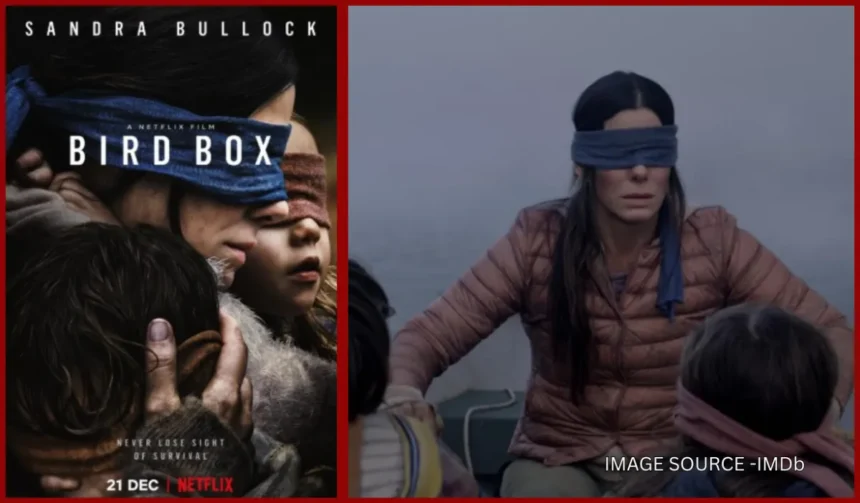
Bird Box Movie Explained & Ending Explained
Surviving the Unseen Apocalypse
🗓️ Release Year
2018
📺 Streaming On
IMDb
6.6/10
Rotten Tomatoes
64%
Critics Score
1. Bird Box Movie Explained: Plot, Themes, and That Shocking Twist
Netflix’s 2018 global phenomenon, Bird Box, is more than a simple apocalyptic thriller. It’s a tense, psychological exploration of motherhood, trauma, and the primal fear of the unknown. Directed by Susanne Bier, the film captivated audiences with its chilling premise: an unseen force that drives people to suicide upon sight.
But what are these entities? What does the ending truly mean? This article provides a complete Bird Box movie explained breakdown, followed by a detailed Bird Box ending explained analysis. We’ll dissect the plot, uncover the core themes, and reveal what the sanctuary at the river truly represents.
2. Overview
Bird Box is a post-apocalyptic horror-thriller that masterfully builds tension through sensory deprivation. The film’s mood is consistently bleak, anxious, and claustrophobic, punctuated by moments of devastating loss and fragile hope.
With a runtime of 124 minutes, it weaves between two timelines: the chaotic onset of the apocalyptic event and a perilous river journey five years later. The central movie mechanic—the necessity of blindfolds—forces characters and viewers alike to rely on sound and instinct, creating a uniquely immersive and terrifying experience.
3. SPOILER WARNING
4. Story Explained (Full Breakdown)
Act 1: The Onset of Chaos
The film opens with Malorie Hayes (Sandra Bullock), a pregnant and emotionally closed-off artist. Her life is irrevocably shattered when news reports of mass suicides spread globally. The cause: mysterious entities that, when seen, manifest a person’s deepest sorrow or fear, driving them to immediate self-destruction.
Malorie finds refuge in a house with a group of survivors, including the pragmatic Greg (BD Wong), the empathetic Tom (Trevante Rhodes), and the unstable Gary (Tom Hollander). They learn the rules: cover all windows, never look outside, and venture out only when blindfolded. Birds in a box become a crucial early-warning system, growing agitated when the entities are near.
Act 2: Survival and Betrayal
The sheltered existence within the house is a pressure cooker of paranoia. Tensions flare over resources, risk, and leadership. The group discovers that some who have seen the entity and survived—like the mysterious Gary—have become psychologically “infected.” They worship the creatures and actively try to make others look, believing they will see a sublime beauty.
Gary’s betrayal is catastrophic. He unveils a drawing of the entity, causing multiple survivors to see it and die. In the ensuing chaos, only Malorie, Tom, and two newborns—a boy and a girl—escape. The film then jumps five years later. Malorie, now a hardened survivor, raises the children, whom she pointedly calls “Boy” and “Girl,” training them with ruthless discipline to hone their hearing and avoid any curiosity about the outside world.
Act 3: The Desperate Journey
Malorie receives a radio message from a supposed safe haven: a sanctuary for the blind, located two days down a treacherous river. With Tom having died protecting them earlier, Malorie embarks on the journey alone with the two children. The river sequence is the film’s tense climax.
Blindfolded, they navigate rapids, evade whispering entities on the banks, and face the ultimate test of trust and instinct. The final stretch requires them to leave the boat and walk through a forest to the river’s sound, completely vulnerable. It is here that Malorie must finally choose between her survivalist dogma and the maternal love she has long suppressed.

5. Key Themes Explained
Motherhood and Emotional Vulnerability: At its heart, Bird Box is about Malorie’s journey from detachment to connection. Her initial refusal to name the children symbolizes her fear of love and subsequent loss. The apocalypse becomes a metaphor for the terrifying vulnerability of parenthood.
The Nature of Fear and Madness: The entity doesn’t kill directly; it weaponizes a person’s own mind. This explores how true horror is often internal. The “infected” like Gary represent a different madness—one of fanatical acceptance, posing the question: is it worse to be destroyed by your fears or seduced by them?
Sight vs. Perception: The film argues that literal sight is a liability. True “vision” comes from listening, trusting, and feeling. The sanctuary being a school for the blind reinforces this: those who never relied on sight are inherently better adapted to this new world.
6. Characters Explained
Malorie (Sandra Bullock): Her arc is the spine of the movie. She begins as a character who sees motherhood as a biological duty. The apocalypse forces her to become a protector, but through Tom’s kindness and the children’s humanity, she rediscovers the courage to love, transforming from “just a mother” to “their mother.”
Tom (Trevante Rhodes): He represents the preserved hope and community that Malorie initially rejects. His death is not just a loss of protection but a loss of the moral compass for their tiny family. His memory guides her final choice.
Gary (Tom Hollander): The film’s most chilling antagonist because his evil is ideological. He believes he is offering salvation, not death. He represents the danger of charismatic fanaticism that preys on despair.
7. Twist Explained
The core twist isn’t a traditional plot revelation but a conceptual one: the creatures are not intentionally malicious, and they can be survived. The film gradually reveals that the entities’ effect is based on the viewer’s psychology. Psychopaths or those with a certain mental resilience, like Gary and later the blind residents of the sanctuary, can see them without dying.
This reframes the entire apocalypse. It’s not an invasion but an ecological or evolutionary event that simply exposes the fragility of the human psyche. The real battle is internal.
8. Movie Ending Explained
What Happens: After the harrowing river journey, Malorie and the children reach the sanctuary. It’s a former school for the blind, now a thriving community led by Dr. Lapham. The birds are free here, no longer caged. Malorie, for the first time, allows the children to remove their blindfolds in safety. In a moment of profound emotional release, she names them Olivia and Tom.
What the Ending Means: The sanctuary symbolizes a new paradigm for humanity. The blind, who already perceive the world without sight, are the natural inheritors of this new world. Their community thrives on cooperation and trust, not fear and isolation.
Malorie naming the children is the culmination of her arc. By giving them the names of her lost sister (whose death she felt guilty for) and her lost love, she integrates her past trauma into her present love. She is no longer just surviving; she is living, remembering, and honoring.
Alternate Interpretations & Director’s Intention: Some viewers question if the sanctuary is real or a final delusion before death. However, the director’s intention, supported by the source novel, leans toward hope. The ending suggests adaptation, not extinction. The entities have forced a brutal evolution: to survive, humanity must shed its old ways of seeing—both literally and metaphorically—and embrace a deeper, more connected form of perception.

9. Performances
Sandra Bullock delivers a career-high performance of raw, gritted-teeth intensity. She masterfully portrays Malorie’s transformation without sentimentality, making her final moments of vulnerability immensely powerful. Trevante Rhodes provides the film’s crucial emotional warmth, grounding the story in genuine humanity.
A standout is Tom Hollander as Gary. He is utterly convincing in his serene menace, making a character who could have been a simple villain into a deeply unsettling portrait of fanaticism. The child actors, particularly Vivien Lyra Blair, perform remarkably under physically demanding and restrictive conditions.
10. Direction & Visuals
Director Susanne Bier focuses on close-ups and shallow focus to trap us in the characters’ limited perspectives. The cinematography is deliberately desaturated in the “present” timeline, reflecting the bleakness of their world, while flashbacks have a warmer, more tragic glow.
The sound design is the film’s unsung hero. It becomes our primary sensory input, making every rustle, whisper, and bird chirp laden with terrifying potential. The decision to never visually define the entities is its smartest aesthetic choice, leveraging the audience’s imagination to generate fear.

11. Pros and Cons
Pros:
- A compelling, high-concept premise executed with relentless tension.
- Sandra Bullock’s powerful, anchoring performance.
- Brilliant use of sound and sensory deprivation to create fear.
- A thematically rich exploration of motherhood and trauma.
Cons:
- Some characterizations in the survivor group feel thin.
- The film’s logic has notable plot holes (e.g., how do the infected avoid seeing the entity constantly?).
- The pacing in the middle section can feel repetitive.
12. Cast
| Actor/Actress | Character | Role Description |
|---|---|---|
| Sandra Bullock | Malorie Hayes | The protagonist, a hardened survivor learning to embrace motherhood. |
| Trevante Rhodes | Tom | A kind-hearted survivor who becomes Malorie’s emotional anchor. |
| John Malkovich | Douglas | A cynical, pragmatic survivor in the initial safe house. |
| Sarah Paulson | Jessica | Malorie’s sister, one of the first victims of the entity. |
| Tom Hollander | Gary | An “infected” survivor who becomes a fanatical antagonist. |
| BD Wong | Greg | A resourceful survivor in the initial safe house. |
| Jacki Weaver | Cheryl | An older, nurturing survivor. |
| Vivien Lyra Blair | Girl/Olivia | One of the children Malorie protects. |
13. Crew
| Role | Name | Notable Contribution |
|---|---|---|
| Director | Susanne Bier | Brought a character-driven, psychological intensity to the thriller. |
| Screenplay | Eric Heisserer | Adapted Josh Malerman’s novel, focusing on Malorie’s emotional arc. |
| Cinematographer | Salvatore Totino | Created the distinct visual contrast between the two timelines. |
| Composer | Trent Reznor & Atticus Ross | Provided an atmospheric, unsettling electronic score. |
14. Who Should Watch?
Fans of psychological horror and post-apocalyptic survival stories like A Quiet Place will find much to appreciate. It’s also a compelling watch for those interested in character studies about trauma and resilience. However, viewers sensitive to themes of suicide and intense suspense should approach with caution.
15. Verdict
Bird Box is a gripping and thought-provoking thriller that transcends its monster-movie logline. While it has some narrative imperfections, its strengths lie in Sandra Bullock’s formidable performance, its masterful building of blindfolded tension, and its surprisingly poignant core about choosing love in the face of overwhelming fear. The Bird Box ending explained not as a final defeat, but as a hard-won new beginning, leaves a lasting, resonant impact.
16. Reviews & Rankings
| Source | Score | Verdict Summary |
|---|---|---|
| IMDb User Score | 6.6/10 | A popular hit with audiences, praised for its suspense but critiqued for its plot logic. |
| Rotten Tomatoes (Critics) | 64% | Critics found it a “reasonably suspenseful” thriller elevated by Bullock’s performance. |
| Rotten Tomatoes (Audience) | 58% | A more divided audience reception, often comparing it to similar films like A Quiet Place. |
| Common Sense Media | 4/5 | Notes intense scares but highlights themes of perseverance and parental love. |
17. Where to Watch
Bird Box is available for streaming exclusively on Netflix. It remains one of the platform’s most-watched original films to date.


