
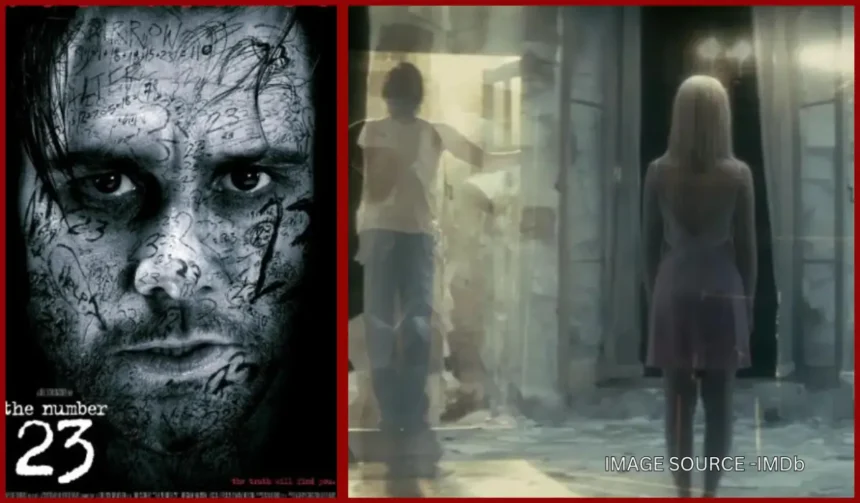
The Number 23 Movie Explained & Ending Explained
Jim Carrey’s Dark Descent into a Numerological Obsession
🗓️ Release Year
2007
📺 Streaming On
Tubi
IMDb
6.4/10
Rotten Tomatoes
8%
Critic Score
1. The Number 23 Movie Explained: Unraveling the Mystery & Twist
Welcome to our deep-dive Movie Explained and Ending Explained guide for the 2007 psychological thriller The Number 23. Starring Jim Carrey in a dramatic departure from his comedic roles, this film plunges into the terrifying world of obsession, guilt, and fractured identity.
We will unravel the entire plot, break down the film’s key themes, and provide a clear explanation of its complex, twist-filled ending. Whether you just finished watching and are left with questions, or are curious about the film’s mysteries, this guide will cover everything you need to know.
2. Overview
The Number 23 is a neo-noir psychological thriller directed by Joel Schumacher. The movie leverages a dark, paranoid mood, blending elements of mystery and horror. It explores the concept of apophenia—the human tendency to see meaningful patterns in random data.
With a runtime of 101 minutes, the film is a tense character study. It asks a compelling question: can a simple number hold a curse, or does the curse come from within our own minds? The movie is a stark contrast to Jim Carrey’s typical filmography, showcasing his range as a serious actor.
3. SPOILER WARNING
⚠️ MAJOR SPOILERS AHEAD ⚠️
This article contains a full, detailed breakdown of *The Number 23*, including all major plot points, character revelations, and the ending. Proceed only if you’ve seen the film.
4. Story Explained (Full Breakdown)
Act 1 Explained: The Seed of Obsession
Walter Sparrow (Jim Carrey) is a mild-mannered animal control officer living a content, ordinary life with his wife Agatha (Virginia Madsen) and son Robin. On his birthday, Agatha gifts him a mysterious, self-published novel titled The Number 23, authored by someone named Topsy Kretts.
As Walter begins reading, he is unnerved. The novel’s protagonist, a hardboiled detective named Fingerling, seems to share eerie parallels with his own life. More disturbingly, Fingerling becomes obsessed with the number 23, believing it to be a malevolent force connecting all events. Walter starts seeing the number everywhere—in dates, addresses, and random phrases. His initial curiosity morphs into a compulsive, all-consuming obsession.
Act 2 Explained: The Descent into Paranoia
Walter’s obsession strains his family life. He becomes convinced the book is more than fiction; it’s a warning or a hidden confession. He discovers that the book’s author, Topsy Kretts (a pun for “Top Secrets”), may be connected to a real, unsolved murder from years ago: the death of a young woman named Laura Tollins.
Walter, now fully identifying with Fingerling, begins an amateur investigation. He tracks down people from the author’s past, including a seductive femme fatale named Fabricia (also played by Madsen) and a university professor, Dr. Leary. The line between Walter’s reality and the noir fantasy of the book blurs completely. He becomes paranoid, aggressive, and convinced he is being guided—or cursed—by the number to a dark truth.
Act 3 Explained: Confronting the Source
Walter’s investigation leads him to the old, gothic mansion where Laura Tollins was killed. There, he confronts Dr. Leary, who reveals a shocking piece of the puzzle. The real author of the book is not a mysterious stranger.
Walter is forced to face the terrifying possibility that the book originated from his own mind. The final act is a race against his own crumbling psyche to piece together his fragmented memories before he loses himself—and his family—forever.
5. Key Themes Explained
Obsession and Apophenia: The core theme is the human mind’s power to create meaning from chaos. The number 23 itself is meaningless; its power is bestowed entirely by Walter’s focus. The film is a case study in how obsession can build a self-fulfilling prison of belief.
Guilt and Repressed Memory: The narrative is ultimately driven by deep, psychological guilt. The “curse” of the number is a metaphor for the inescapable weight of a past traumatic act. The mind, unable to cope, creates elaborate stories to distance itself from the truth.
Duality and Identity: This is visualized through the Walter/Fingerling dichotomy. Fingerling represents Walter’s repressed id—violent, sexual, and cynical. Walter’s journey is about integrating these split halves of his personality and accepting his whole, flawed self.

6. Characters Explained
Walter Sparrow / Fingerling (Jim Carrey): Walter is a man living a life of constructed normalcy, subconsciously atoning for a past sin. Fingerling is his psychological shadow-self, a projection of his guilt and violent potential. Carrey’s performance hinges on making both men distinct yet eerily connected.
Agatha Sparrow / Fabricia (Virginia Madsen): Agatha represents stability, love, and the anchor to reality. Her dual role as Fabricia in the novel sequences symbolizes temptation and the dangerous, unknown aspects of Walter’s past that she is connected to.
Dr. Isaac French / Dr. Leary (Danny Huston): The college professor serves as a mentor and a gateway to the past. He holds the key to the historical truth that Walter has buried, acting as a reluctant guide back to the source of the trauma.
7. Twist Explained
The central twist of The Number 23 is that Walter Sparrow is both the author of the book and the perpetrator of the crime it describes.
Years earlier, as a jealous and unstable college student dating Laura Tollins (Agatha’s friend), Walter discovered Laura kissing Dr. French. In a rage, he accidentally pushed her from a balcony, killing her. The trauma was so severe that he completely dissociated, creating a new identity—Walter Sparrow—and repressing the memory.
The novel The Number 23 was a subconscious confession, written by him during a fugue state. The name “Topsy Kretts” is his psyche’s cryptic label for these buried “top secrets.” Every clue and pattern he sees in the number is his own mind trying to lead him back to the truth he cannot consciously face.

8. Movie Ending Explained
What Exactly Happens?
In the climax, Walter returns to the tower where Laura died. He fights with Dr. French, who finally reveals that Walter wrote the book. This triggers Walter’s full memory of the tragic night. Overcome with guilt and believing his family is better off without a murderer, Walter attempts suicide by jumping from the same tower.
He survives the fall, and in the hospital, he fully confesses everything to Agatha. The film ends with Walter, now bearing the physical and psychological scars, visiting Laura’s grave with his family. He places the finished, blood-stained manuscript on her tombstone, a final act of acknowledgment and atonement.
What The Ending Means
The ending is about integration and acceptance, not escape. Walter’s survival symbolizes that he must live with his past, not die because of it. By confessing to Agatha and facing the consequences, he finally merges the identities of Walter and Fingerling. He is no longer a man haunted by a shadow; he is a whole man carrying a terrible truth.
Placing the book on the grave represents laying his confession—and his obsession—to rest. The curse of the number 23 is broken because its purpose is complete: it guided him, however painfully, back to the truth he had hidden from himself.
Alternate Interpretations
Some viewers posit that the “accident” may not have been so accidental. Fingerling’s violent nature in the book could suggest a more intentional act, which Walter’s mind softened into an accident to make it survivable. The ending allows for this ambiguity—the core truth is his guilt, but the precise nature of the sin remains slightly clouded by his own psyche’s defenses.
Director’s Intention
Director Joel Schumacher crafted the film as a Gothic noir about self-forgiveness. The stylistic split between Walter’s drab reality and Fingerling’s stylized, red-hued world visually illustrates the split mind. The ending’s intention is cathartic, suggesting that true peace comes not from forgetting, but from remembering and seeking forgiveness, especially from oneself.

9. Performances
Jim Carrey delivers a committed, intense performance that is the film’s anchor. His portrayal of Walter is convincingly meek and unraveling, while his Fingerling is suitably sleazy and unhinged. The criticism lies not in his effort, but in the script’s occasional inability to fully ground his character’s extreme shifts.
Virginia Madsen provides crucial emotional stability. She deftly handles her dual roles, making Agatha’s loyalty heartbreaking and Fabricia’s allure dangerous. She is the human center around which Carrey’s chaos orbits.
The supporting cast, including Danny Huston, is solid but underutilized, often serving more as plot devices than fully realized characters.
10. Direction & Visuals
Joel Schumacher employs a heavy-handed but effective visual dichotomy. Walter’s world is often shot in cool, muted blues and greys, reflecting his depression and detachment. The Fingerling segments are drenched in high-contrast noir aesthetics: harsh shadows, Venetian blinds, and a pervasive, hellish red tone that screams danger and passion.
The cinematography uses disorienting angles and rapid cuts during Walter’s paranoid episodes to put the audience inside his deteriorating mind. The visual symbolism of spirals, mazes, and the ever-present number 23 constantly reinforces the theme of being trapped in a self-made psychological labyrinth.
11. Pros and Cons
Pros:
- A compelling, high-concept premise about obsession.
- Jim Carrey’s serious and daring performance.
- Effective, stylized visuals that separate the two realities.
- A genuinely clever core twist that re-contextualizes the entire narrative.
Cons:
- The plot can feel repetitive as Walter finds yet another “23.”
- The dialogue, especially in the noir segments, can veer into the cheesy and melodramatic.
- The third-act exposition dump from Dr. Leary feels rushed and mechanical.
- The film’s logic heavily relies on accepting extreme psychological dissociation.
12. Cast
| Actor | Character | Role Description |
|---|---|---|
| Jim Carrey | Walter Sparrow / Fingerling | An animal control officer whose life spirals when he becomes obsessed with a mysterious number. |
| Virginia Madsen | Agatha Sparrow / Fabricia | Walter’s loyal wife who becomes worried by his descent, and the seductive character from the novel. |
| Logan Lerman | Robin Sparrow | Walter and Agatha’s teenage son. |
| Danny Huston | Dr. Isaac French / Dr. Leary | A college professor with a connection to Walter’s hidden past. |
| Lynn Collins | Suicide Blonde | A young woman from Fingerling’s story. |
13. Crew
| Role | Name | Notable Other Work |
|---|---|---|
| Director | Joel Schumacher | The Lost Boys, Falling Down, Phone Booth |
| Writer | Fernley Phillips | (Debut Feature Film) |
| Cinematographer | Matthew Libatique | Black Swan, Requiem for a Dream |
| Composer | Harry Gregson-Williams | The Chronicles of Narnia, Kingdom of Heaven |
14. Who Should Watch?
- Viewers interested in psychological thrillers about obsession and guilt.
- Fans of Jim Carrey wanting to see his dramatic capabilities.
- Audiences who enjoy “unreliable narrator” stories and mind-bending twists.
- Those who appreciate stylized, neo-noir visual aesthetics.
15. Verdict
The Number 23 is a flawed but fascinating psychological thriller. While its execution sometimes stumbles into repetition and melodrama, its core concept is strong and its central twist is psychologically sound. The film succeeds as a dark exploration of how guilt can manifest as external obsession. Jim Carrey’s serious turn is commendable and grounds the film’s more outlandish elements. In the end, it’s a memorable, if imperfect, dive into one man’s haunted numerology.
16. Reviews & Rankings
Critical Consensus Summary:
The film was panned by most critics upon release, who criticized its contrived plot and heavy-handed approach. However, it has developed a cult following among audiences who appreciate its unique premise and Carrey’s performance.
| Source | Score | Verdict Snippet |
|---|---|---|
| Rotten Tomatoes | 8% (Critics) | “A tiresome thriller that squanders its intriguing premise…” |
| IMDb | 6.4/10 (Users) | “Underrated. Carrey is great and the idea is creepy.” |
| Common Sense Media | 3/5 | “Dark, violent thriller for older teens and up.” |
17. Where to Watch
As of this writing, The Number 23 is available to stream for free with ads on Tubi. It is also available for digital rental or purchase on platforms like Amazon Prime Video, Apple TV, and Google Play.
Watch the unraveling of obsession on Tubi.


