
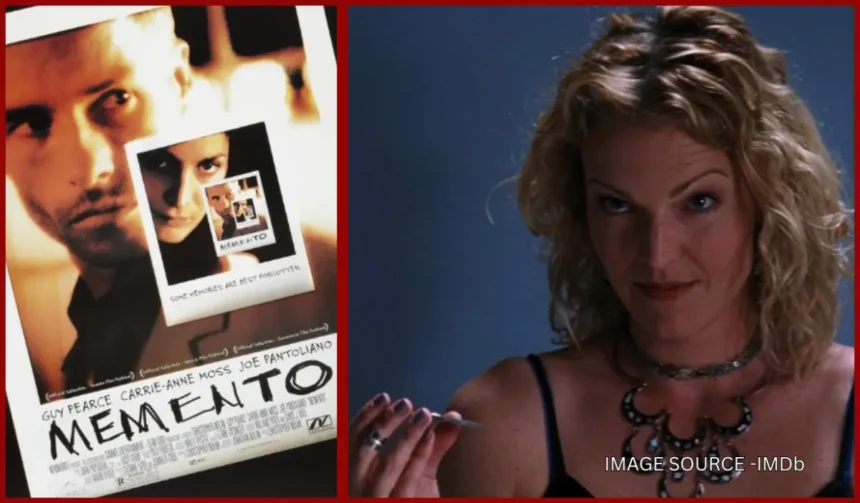
Memento Explained: The Mind-Bending Mystery & Ending Decoded
Unraveling Christopher Nolan’s Masterpiece of Memory and Deceit
🗓️ Release Year
2000
📺 Streaming On
Prime Video
IMDb
8.4/10
Rotten Tomatoes
93%
Certified Fresh
Welcome to a deep dive into one of the most ingenious films ever made. This Memento Explained guide is your definitive companion to Christopher Nolan’s 2000 neo-noir psychological thriller. More than just a movie, Memento is an experience—a narrative labyrinth that places you directly inside the fractured mind of its protagonist.
We will unravel the movie’s unique structure, break down its complex plot in simple terms, and explore its profound themes. Most importantly, we will dedicate a detailed section to the Memento ending explained, dissecting that final, breathtaking revelation that recontextualizes everything you’ve just seen. If you’ve finished the film feeling intrigued, confused, or desperate for answers, you’re in the right place.
Overview
Memento is a groundbreaking film that defies conventional storytelling. Directed by a young Christopher Nolan and based on a story by his brother Jonathan, the movie blends the genres of mystery, thriller, and psychological drama into a relentless puzzle.
The mood is paranoia-soaked and claustrophobic. We are trapped in a perspective where the past is a shifting, unreliable story. With a tight runtime of 113 minutes, the film uses its innovative structure—scenes in color run in reverse order, interspersed with black-and-white sequences moving forward—to create a visceral simulation of short-term memory loss. It’s a cerebral, unsettling, and utterly compelling cinematic experiment.
SPOILER WARNING
⚠️ MAJOR SPOILERS AHEAD
This article is a full “Movie Explained” and “Ending Explained” breakdown. We will discuss all major plot points, character motivations, and the film’s final twists in detail. If you haven’t seen Memento, proceed with caution.
Story Explained (Full Breakdown)
To understand Memento, you must understand its structure. The film tells two parallel stories: the black-and-white segments (told chronologically) and the color segments (shown in reverse order). They converge at the climax. Let’s break it down.
Act 1 Explained (The End, in Color)
We open on a Polaroid photo developing backwards—our first clue that time is being manipulated. Leonard Shelby (Guy Pearce) is in a derelict building. He kills Teddy (Joe Pantoliano), a man he believes is his wife’s murderer, “John G.” Leonard explains his condition, anterograde amnesia, which prevents him from making new memories since the night of his wife’s assault. He relies on notes, Polaroids, and intricate tattoos to track clues. This opening scene is, in fact, the chronological end of the film’s story.
Act 2 Explained (The Middle, in Reverse)
The color scenes now roll backwards. We see Leonard interacting with Natalie (Carrie-Anne Moss), a bartender who seems to pity then manipulate him. He is also guided by Teddy, who claims to be an undercover cop helping him. We see Leonard burn a photo of Teddy with the note “Don’t believe his lies,” and get the tattoo “Fact 6: Car license SG13 7IU.” Each prior color scene shows us the cause of the effect we just witnessed. We see him being used as a pawn to scare off drug dealers and being fed false clues, all while he doggedly pursues his mission.
Act 3 Explained (The Beginning, in Black & White)
Interspersed throughout are the chronological black-and-white sequences. Here, Leonard is in a motel room, talking on the phone, recounting the story of Sammy Jankis, another man with the same condition. This serves as Leonard’s origin story and his personal parable. These scenes show him gathering information, preparing his system, and interacting with a caller (who we later learn is Teddy). This timeline moves forward until it literally turns into color at the moment the two timelines converge: when Leonard chooses his new “fact” and sets off to kill the man he’s just identified.

Key Themes Explained
Memento is about far more than a memory-challenged man hunting a killer. Its core themes dissect the human psyche.
The Construction of Self Through Narrative: Leonard says, “We all need memories to know who we are. I’m not who I was.” The film argues that identity is not fixed but is a story we constantly tell ourselves. Leonard’s mission gives him purpose and an identity—“the avenger”—even if that story is built on a lie.
The Desire to Believe vs. The Need to Know: Leonard’s condition makes him the ultimate unreliable narrator. He consciously chooses to ignore evidence (like burning the Polaroid of Teddy) to preserve his purpose. The film asks: Is it better to live a satisfying lie or a painful truth? Leonard consistently chooses the lie.
The Cycle of Violence and Self-Deception: Leonard’s quest is revealed to be a perpetual loop. By the end, he is destined to repeat the same actions, hunting a new “John G” to give his life meaning. The vengeance is never complete because completion would mean facing the emptiness of his existence.
Characters Explained
Leonard Shelby: A tragic figure trapped in a 15-minute loop. His drive for vengeance is his entire personality, but it’s a shield. Deep down, he may be fleeing a truth too terrible to remember. His manipulation of “facts” shows he is not a passive victim but an active participant in his own deception.
Teddy (John Gammell): A corrupt undercover cop. He initially seems to be using Leonard for his own ends, like taking drug money. His final monologue reveals a more complex role: he was Leonard’s original “John G,” the one who truly avenged his wife. Now, he’s both Leonard’s handler and his eventual prey, caught in the cycle he helped create.
Natalie: A wolf in sheep’s clothing. Grieving her own lost lover, she expertly identifies and weaponizes Leonard’s condition. Her cruelty (the note game, sending him on errands) demonstrates how vulnerable Leonard truly is. She uses his need for a narrative to serve her vengeance.
Sammy Jankis: The story’s haunting parable. Leonard presents Sammy as a separate case study of the same condition. The devastating conclusion is that Sammy’s story is likely Leonard’s own story, projected onto another man to absolve himself of guilt.
Twist Explained
The film’s central, gut-punching twist is dual-layered:
- Teddy’s Revelation: Teddy tells Leonard that he already found and killed his wife’s real attacker over a year ago. Leonard, unable to remember this or find a new purpose, wrote himself a note to “condition” himself to deny Teddy (“Don’t believe his lies”) and created a new “John G” to hunt—Teddy himself.
- The Sammy Jankis Transference: The deeper twist is that the Sammy Jankis story is Leonard’s memory, distorted. Teddy implies that Leonard’s wife survived the assault. It was Leonard, due to his condition, who accidentally killed her via insulin overdose, just like the story he tells about Sammy. Leonard has invented the Sammy persona to bury his own unbearable guilt.
These twists reveal that Leonard is not a detective solving a mystery, but a man endlessly manufacturing one to escape his past.

Movie Ending Explained
The Memento ending is a masterclass in tragic, cyclical storytelling. Let’s break down the final moments.
What Exactly Happens?
In the chronological final scene (the first color scene we see), Leonard kills Teddy in the derelict building. Before he dies, Teddy delivers the crushing truth: Leonard’s wife survived the assault, Leonard himself killed her via insulin, and Teddy helped him find and kill the real “John G” a year ago. He calls Leonard “a freak” who will just invent another puzzle to solve. Leonard, in denial, writes down Teddy’s license plate as the “fact” for his next John G. He burns a photo of dead Teddy, keeps one of him alive to target, and gets a tattoo of the license plate. He then gets into Teddy’s car, and in his mind, the hunt begins anew.
What The Ending Means & How It Connects to the Theme
The ending is the loop closing—and immediately restarting. Leonard’s final line, “Now, where was I?” is chilling. It signifies he has already begun forgetting the painful truth and is re-immersing himself in his fabricated narrative. The theme of self-deception for survival is complete. He chooses the lie (“We all lie to ourselves to be happy”) because the truth offers only emptiness and monstrous guilt.
Alternate Interpretations
Some viewers posit that Teddy is lying to save his own skin, making the entire “you did it” story a fabrication. However, the film’s evidence (the lack of insulin needle marks on Sammy’s wife in Leonard’s memory, Teddy’s knowledge of Leonard’s pre-condition life) strongly supports Teddy’s version as the film’s intended reality.
Director’s Intention
Christopher Nolan crafted the structure to make the audience feel Leonard’s disorientation. The ending forces us to realize we’ve been complicit in Leonard’s delusion, piecing together a mystery he designed to remain unsolvable. It’s a critique of the very nature of cinematic narrative and our desire for a satisfying conclusion. Nolan gives us an ending, but no closure.
Performances
Guy Pearce delivers a career-defining performance. He must portray a man with no short-term memory without becoming a robotic gimmick. Pearce finds the human desperation, the flickers of doubt, and the terrifying determination beneath. His Leonard is both pitiable and frightening.
Carrie-Anne Moss subverts her The Matrix persona entirely. Her Natalie is a nuanced manipulator, seamlessly shifting between vulnerable warmth and冰冷, calculating cruelty. You never know which version is real, which is the point.
Joe Pantoliano is perfectly cast as Teddy. He masterfully walks the line between sleazy opportunist and weary truth-teller. His final monologue is delivered not with villainous glee, but with a frustrated, almost pitiful exhaustion, making his revelations land with greater force.
Direction & Visuals
Nolan’s direction is a brilliant formal exercise. The reversed color sequence is not a gimmick but the film’s central metaphor—every scene starts with a question (an effect) and moves to an answer (a cause), mirroring Leonard’s detective work.
Cinematographer Wally Pfister uses a gritty, realistic palette for the color scenes, emphasizing Leonard’s stark, immediate reality. The black-and-white sequences feel more like memories or internal monologue, sterile and timeless.
The visual symbolism is potent: the Polaroids (fading memories), the tattoos (permanent, possibly false facts), the repeated shots of Leonard’s empty motel room (his cyclical existence). Every frame reinforces the themes of fragmentation and reconstruction.

Pros and Cons
Pros:
- A revolutionary, intellectually exhilarating narrative structure.
- A-tier performances that ground the high-concept plot.
- Deep, philosophical themes that resonate long after viewing.
- A perfectly executed twist that rewards multiple viewings.
- Tight, economical filmmaking with zero fat.
Cons:
- The fragmented narrative can be alienating for some viewers.
- The emotional core is intentionally cold, which may leave some feeling detached.
- The complexity demands full attention; it’s not a casual watch.
Cast
| Actor | Character | Role Description |
|---|---|---|
| Guy Pearce | Leonard Shelby | An insurance investigator with anterograde amnesia on a quest for vengeance. |
| Carrie-Anne Moss | Natalie | A mysterious bartender who manipulates Leonard for her own ends. |
| Joe Pantoliano | Teddy (John Gammell) | A corrupt undercover cop with a complex connection to Leonard’s past. |
| Mark Boone Junior | Burt | The motel clerk who rents multiple rooms to Leonard. |
| Stephen Tobolowsky | Sammy Jankis | A man with a similar condition, central to Leonard’s personal parable. |
| Harriet Sansom Harris | Mrs. Jankis | Sammy’s wife, a tragic figure in Leonard’s story. |
Crew
| Role | Name | Notable Contribution |
|---|---|---|
| Director | Christopher Nolan | Crafted the iconic reverse-chronology structure and exacting vision. |
| Writer | Christopher Nolan | Adapted the screenplay from his brother Jonathan Nolan’s short story. |
| Cinematographer | Wally Pfister | Created the distinct visual language separating memory from present action. |
| Composer | David Julyan | Provided the minimalist, haunting, and suspenseful score. |
| Editor | Dody Dorn | Achieved the monumental task of weaving two timelines into a coherent whole. |
Who Should Watch?
- Fans of psychological thrillers and intricate, puzzle-box narratives.
- Viewers who appreciate films that demand active engagement and analysis.
- Anyone interested in the mechanics of memory, identity, and self-deception.
- Not recommended for those seeking a straightforward, action-driven plot or a light viewing experience.
Verdict
Memento is a landmark achievement in modern cinema. It is a dazzling intellectual puzzle, a profound character study, and a formal masterclass all in one. While its structure is famously complex, its emotional core—a devastating portrait of a man choosing a lie to survive—is brutally simple. The Memento ending explained isn’t just a solution to a mystery; it’s the key to understanding the film’s tragic, eternal loop. This is not just a movie to watch, but an experience to be unraveled and pondered for years to come.
Reviews & Rankings
| Source | Rating | Comment Summary |
|---|---|---|
| IMDb User Score | 8.4/10 | Consistently ranked among the top thrillers for its brilliant plot. |
| Rotten Tomatoes | 93% (Critics) | Hailed as “a modern noir masterpiece” and “mind-blowing.” |
| Metacritic | 80/100 | “Universal acclaim” for its innovation and execution. |
| Roger Ebert (2001) | 3.5/4 | Praised its structure but noted the “puzzle” can overshadow the “pain.” |
Where to Watch
Memento is available for streaming rental or purchase on major platforms. It is also frequently included in catalog subscriptions. Watch this cinematic puzzle on Prime Video, or check other digital retailers like Apple TV and Google Play.


