
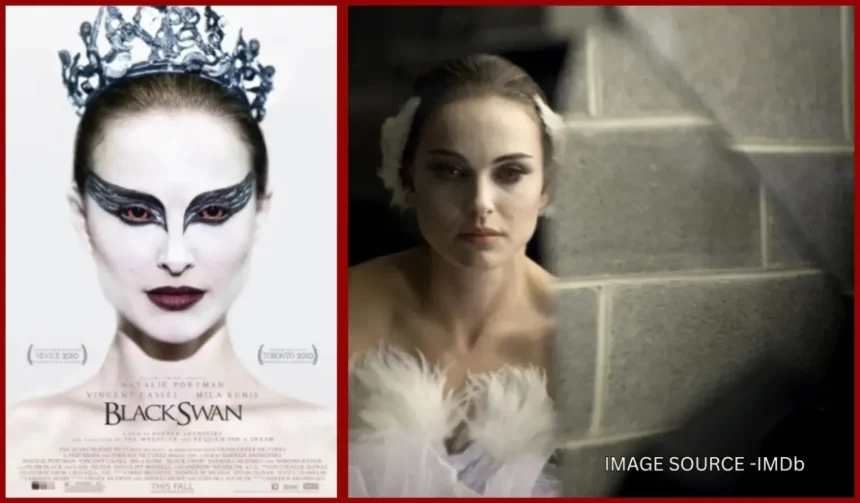
Black Swan
A Psychological Horror Ballet
🗓️ Release Year
2010
📺 Streaming On
Paramount+
IMDb
8.0/10
Rotten Tomatoes
85%
Critic Score
1. Black Swan Ending Explained: A Descent Into Madness
Darren Aronofsky’s Black Swan is far more than a movie about ballet. It is a visceral, psychological horror film that uses the art form as a backdrop for a terrifying exploration of perfection, identity, and self-destruction. This Movie Explained and Ending Explained guide will dissect the haunting journey of Nina Sayers.
We will break down the plot’s three acts, decode its rich symbolism, and analyze the complex characters. Most importantly, we will delve deep into that shocking, ambiguous finale. What really happens to Nina? This article provides a clear, expert analysis of one of modern cinema’s most discussed endings.
2. Overview
Black Swan (2010) is a psychological thriller-horror film that blurs the line between reality and hallucination. Set in the high-pressure world of a New York City ballet company, the film follows a dedicated but fragile dancer as she wins the lead role in Swan Lake.
The mood is one of escalating paranoia, claustrophobia, and Gothic dread. With a runtime of 108 minutes, the movie is a tight, intense experience. It masterfully uses the duality of the White Swan and Black Swan from Tchaikovsky’s ballet as a metaphor for its central conflict.
3. SPOILER WARNING
⚠️ FULL SPOILERS AHEAD
This article contains a complete breakdown of Black Swan, including major plot points, twists, and a detailed analysis of the ending. Proceed only if you’ve seen the film or don’t mind spoilers.
4. Story Explained (Full Breakdown)
Act 1 Explained: The White Swan’s Prison
Nina Sayers (Natalie Portman) is a technically perfect but emotionally restrained ballerina. She lives a sheltered life with her obsessive, controlling mother Erica (Barbara Hershey). When the company’s demanding artistic director, Thomas Leroy (Vincent Cassel), announces a new production of Swan Lake, he needs a dancer who can embody both the pure White Swan and the sensual, wild Black Swan.
Nina auditions and masters the White Swan with ease. However, Thomas doubts her ability to unleash the Black Swan’s passion. He pushes her physically and psychologically, even forcing a kiss upon her. Nina’s pursuit of the role becomes an obsession. She begins to see a potential rival in Lily (Mila Kunis), a new dancer who embodies the free-spirited Black Swan nature Nina lacks.
Act 2 Explained: The Descent Begins
Nina wins the lead role, but the pressure cracks her sanity. She begins experiencing disturbing hallucinations. She scratches a rash on her back, imagines her skin peeling, and sees doppelgängers of herself. Thomas continues to provoke her, suggesting she needs to “touch herself” to discover passion.
Lily, who may be a genuine friend or a manipulative rival, takes Nina out for a night of debauchery. Nina drinks, takes drugs, and engages in a sexual encounter with Lily (or hallucinates that she does). The next morning, hungover and late for rehearsal, she is confronted by an angry Thomas and the former star, Beth (Winona Ryder), whose violent downfall mirrors Nina’s potential fate. Nina’s reality fractures further.
Act 3 Explained: The Metamorphosis
As opening night approaches, Nina’s psychosis intensifies. She believes Lily is conspiring to steal her role. After a violent confrontation with her mother, she locks herself in her bedroom. In a key hallucination, she stabs Lily (who is actually a manifestation of her own Black Swan persona) with a piece of broken glass and hides the body.
On opening night, Nina gives a transcendent performance as the White Swan. Before her Black Swan act, she finds the real Lily in her dressing room to wish her luck, proving the “dead Lily” was a hallucination. However, Nina discovers she has actually stabbed herself with the glass. Embracing the pain and the madness, she delivers a ferocious, perfect performance as the Black Swan.

5. Key Themes Explained
Perfection vs. Passion: The core conflict. Nina’s technical perfection (White Swan) is useless without raw, imperfect passion (Black Swan). The film argues that true artistic greatness requires a surrender of control, a theme Thomas repeatedly hammers home.
Duality and Identity: Nina’s struggle is internal. The “Black Swan” is not Lily, but the repressed part of Nina herself—her sexuality, her aggression, her defiance. The movie visualizes this as a psychological split, culminating in the doppelgänger effects.
Artistic Self-Destruction: The film is a potent allegory for the consuming, often destructive nature of artistic pursuit. To become the Black Swan, Nina must destroy the innocent White Swan, and ultimately, herself. The line between dedication and madness is obliterated.
Mother-Daughter Enmeshment: Erica is a failed dancer who lives vicariously through Nina. She infantilizes her, maintaining a prison of pink, stuffed animals and controlled routines. Nina’s rebellion is as much against her mother as it is for the role.
6. Characters Explained
Nina Sayers: Her arc is a tragic metamorphosis. She begins as a child-woman, seeking external validation from Thomas and her mother. Her journey is an internal war where her repressed id (the Black Swan) violently surfaces to claim dominance, destroying her original ego in the process.
Thomas Leroy: He is the provocateur and a mirror. He recognizes Nina’s potential but uses manipulative, often unethical methods to draw it out. He represents the demanding, sometimes cruel, world of high art that consumes its performers.
Lily: She is the literal and symbolic foil. Whether she is a genuine free spirit or a calculated rival is ambiguous. Functionally, she serves as the projected image of everything Nina is not and must become. She is Nina’s shadow self.
Erica (The Mother): A cautionary figure. Her stifling love and unresolved bitterness create the environment where Nina’s psychosis festers. She is the keeper of the “White Swan” prison.
7. Twist Explained

The film’s central twist is that Nina’s primary antagonist is not Lily, but herself. All the acts of sabotage, the sexual tension, and the final “murder” are manifestations of Nina’s fracturing psyche. The biggest revelation on opening night is that Lily is alive and well.
This proves that the threatening doppelgänger, the passionate lover, and the murdered rival were all hallucinations. Nina’s mind concocted an external villain to rationalize the internal chaos of her transformation. The real violence was turned inward, culminating in her self-inflicted wound.
8. Movie Ending Explained
What Exactly Happens?
After her triumphant Black Swan performance, Nina returns to her dressing room. Lily arrives to congratulate her, but Nina now sees the “corpse” of her hallucination still in the room. The vision vanishes. Lily notices blood soaking through Nina’s costume.
Nina goes on for the White Swan’s final scene, where the Swan Queen dies. As she performs the leap onto the padded mattress, we see she has a large shard of glass embedded in her abdomen. She whispers, “I felt it. Perfect. It was perfect,” to Thomas. As the audience applauds, she lies dying, her white costume staining red, stating, “I was perfect.”
What the Ending Means
The ending is the culmination of Nina’s metamorphosis. To achieve artistic perfection, she had to fully become the Black Swan. This required the symbolic “death” of the innocent, controlled Nina (the White Swan). The physical death we witness is the literal price of that transformation.
Her final words, “I was perfect,” are tragic and triumphant. She achieved the transcendent performance she sought, but the cost was her life. In her mind, this is an acceptable trade. The red bloom on her white costume is the final visual metaphor: passion (black/red) has completely consumed purity (white).
How It Connects to the Theme
The ending directly answers the film’s central question: How far will an artist go for perfection? Black Swan posits that the ultimate artistic expression requires the destruction of the old self. Nina’s death mirrors the Swan Queen’s in the ballet, completing the fusion of art and life. She didn’t just play the role; she lived and died by it.
Alternate Interpretations
Some viewers interpret the ending as entirely metaphorical. They suggest Nina doesn’t physically die, but that the “death” is purely psychological—the final destruction of her former self. The bleeding could be a hallucination. However, the concrete presence of the glass shard and the final, fading shot strongly support a literal reading.
Director’s Intention
Darren Aronofsky crafts the ending as a tragic, beautiful, and complete arc. It follows the logic of a dark fairy tale or a Gothic tragedy. The intention is not to be ambiguous about her death, but to be unambiguous about her achievement. She wins by losing everything, achieving a horrific and sublime perfection.
9. Performances

Natalie Portman delivers a career-defining, physically brutal performance. Her portrayal of Nina’s fragility is heartbreaking, and her transformation into ferocity is utterly convincing. She doesn’t just act the descent; she viscerally embodies it, earning her the Academy Award for Best Actress.
Mila Kunis is perfectly cast as Lily, balancing effortless charm with an underlying ambiguity that keeps the audience guessing. Vincent Cassel is magnetic and intimidating as Thomas, making the manipulative director both repellent and weirdly compelling. Barbara Hershey is devastating as the mother, her quiet menace more terrifying than any monster.
10. Direction & Visuals
Darren Aronofsky’s direction is claustrophobic and subjective. He uses shaky, handheld close-ups, often following the back of Nina’s head, forcing us into her paranoid point-of-view. The color palette is deliberate: Nina’s world is soft pinks, whites, and grays, which are slowly invaded by dark blacks, deep reds, and sinister purples.
The mirror symbolism is relentless. Mirrors reveal doppelgängers, trap Nina, and show her fracturing self. The film’s visual effects are seamlessly integrated to depict bodily horror (scratching, peeling skin) and psychological breakdowns (warping faces, stretching limbs), making the internal turmoil externally visible.
11. Pros and Cons
Pros:
- A masterclass in psychological horror and subjective filmmaking.
- Natalie Portman’s unparalleled, all-in lead performance.
- Brilliant use of ballet as a metaphor for deeper themes.
- A stunning, haunting, and thematically perfect ending.
- Superb supporting cast and immersive direction.
Cons:
- The intense, oppressive atmosphere may be uncomfortable for some.
- Portrays the world of ballet in an extremely dark, potentially stereotypical light.
- The mother character, while effective, borders on archetypal.
12. Cast
| Actor | Character | Role Description |
|---|---|---|
| Natalie Portman | Nina Sayers | The dedicated but fragile ballerina who wins the lead in Swan Lake. |
| Mila Kunis | Lily | A free-spirited new dancer who becomes Nina’s rival and potential friend. |
| Vincent Cassel | Thomas Leroy | The intense, manipulative artistic director of the ballet company. |
| Barbara Hershey | Erica Sayers | Nina’s overbearing, controlling former-dancer mother. |
| Winona Ryder | Beth Macintyre | The company’s former star, forced into retirement. |
13. Crew
| Role | Person | Key Contribution |
|---|---|---|
| Director | Darren Aronofsky | Orchestrated the film’s intense, subjective, and hallucinatory style. |
| Screenwriters | Mark Heyman, Andres Heinz, John J. McLaughlin | Crafted the psychological thriller narrative from Heinz’s original story. |
| Cinematographer | Matthew Libatique | Created the intimate, gritty, and visually symbolic look of the film. |
| Composer | Clint Mansell | Adapted Tchaikovsky’s Swan Lake into a haunting, electronic-driven score. |
| Editor | Andrew Weisblum | Pieced together the film’s rapid, disorienting, and rhythmic pacing. |
14. Who Should Watch?
- Fans of psychological horror and thrillers that prioritize mood over jump scares.
- Viewers interested in complex character studies and explorations of artistry.
- Anyone who appreciates bold, auteur-driven filmmaking with rich symbolism.
- Avoid if you seek a straightforward, uplifting story about ballet or are sensitive to themes of self-harm and psychological breakdown.
15. Verdict
Black Swan is a modern masterpiece of psychological horror. It is a devastating, beautiful, and terrifying film about the cost of perfection. Darren Aronofsky crafts a relentless descent into madness, anchored by Natalie Portman’s fearless, Oscar-winning performance. The movie’s ending, while tragic, provides a thematically flawless and unforgettable conclusion to Nina’s metamorphosis. It’s a film that lingers, disturbs, and demands to be analyzed.
16. Reviews & Rankings
| Source | Score | Verdict Excerpt |
|---|---|---|
| IMDb User Rating | 8.0/10 | “A haunting and brilliant exploration of obsession.” |
| Rotten Tomatoes | 85% | “Bracingly intense, passionate, and wildly melodramatic…” |
| Metacritic | 79/100 | “A full-bore melodrama, sprinkled with horror…” |
| Roger Ebert | 4/4 Stars | “A powerful film that carries us relentlessly…” |
17. Where to Watch
Black Swan is available for streaming on Paramount+ in many regions. It is also available for digital rental or purchase on platforms like Amazon Prime Video, Apple TV, and Google Play.


