
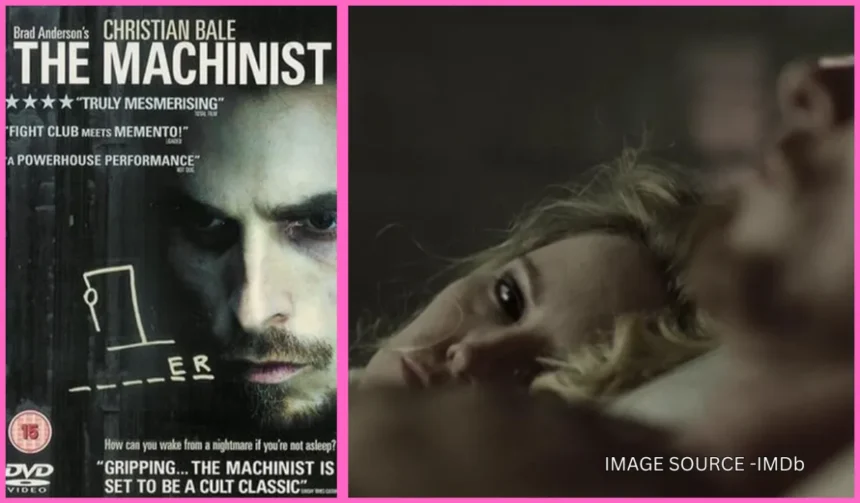
The Machinist Movie Explained + Ending Explained
A Descent Into Guilt, Paranoia, and Redemption
🗓️ Release Year
2004
📺 Streaming On
Tubi (Free)
IMDb
7.7/10
Rotten Tomatoes
77%
1. What Happened in The Machinist? Full Movie Explained + Twist Ending
Welcome to our deep dive into one of the most unsettling psychological thrillers of the 2000s. This article provides a complete The Machinist movie explained and The Machinist ending explained breakdown. We will navigate the foggy, guilt-ridden world of Trevor Reznik, a man literally being consumed by his own mind.
This isn’t just a story about insomnia. It’s a harrowing journey into the human psyche, where reality bends, guilt takes physical form, and redemption comes at a terrifying cost. We’ll unpack the plot, decode its powerful themes, and ultimately reveal what the haunting finale truly means.
Whether you just finished watching and need clarity, or are curious about Christian Bale’s legendary performance, this guide is for you. Let’s step into the grim factory and piece together the puzzle.
2. Overview
The Machinist (2004) is a neo-noir psychological thriller directed by Brad Anderson. It is renowned for its oppressive atmosphere, monochromatic visual style, and a central performance that became the stuff of cinematic legend.
The film follows Trevor Reznik, an industrial machinist who hasn’t slept in a year. His emaciated body and fractured mind are plagued by strange notes, a mysterious co-worker, and a growing conviction that he’s the target of a sinister game. The mood is one of perpetual dread, soaked in greys and blues, making the audience feel Trevor’s exhaustion and paranoia in their bones.
With a runtime of 101 minutes, it’s a tight, relentless character study. It asks a chilling question: What happens when your past crimes won’t let you rest, and your conscience decides to punish you itself?
3. SPOILER WARNING
⚠️ MAJOR SPOILERS AHEAD
This article contains a full, detailed breakdown of The Machinist, including all major plot points and the complete ending. Please watch the movie first for the intended experience.
4. Story Explained (Full Breakdown)
Act 1: The Unraveling
We meet Trevor Reznik, a walking skeleton who works in a noisy machine shop. He lives a sparse, ritualistic life, visiting a prostitute named Stevie and a waitress, Maria, at an airport diner. He is plagued by a series of unsettling events: a mysterious “Hello” post-it on his fridge, an arcade game that glitches with the number “1-8-7” (the police code for murder), and a new, burly coworker named Ivan who no one else seems to acknowledge.
Trevor’s insomnia is complete. He is a ghost in his own life, calculating the days since he last slept. His physical deterioration is alarming. When a horrific accident occurs at the factory—a coworker named Miller loses his arm—Trevor is blamed for causing the distraction. His reality is becoming unstable, and an unseen enemy seems to be closing in.
Act 2: The Descent Into Paranoia
The harassment escalates. Trevor finds photographs of himself asleep at the arcade, contradicting his claim of no sleep. He becomes obsessed with Ivan, who he believes is framing him. He follows Ivan to a fisherman’s wharf, a location that triggers a deep, unsettling anxiety in him.
His relationships fray. His paranoia pushes Maria away after a disastrous date. Stevie grows concerned for his mental state. Trevor’s investigation leads him to Ivan’s apartment, where he finds a file on himself, cementing his belief in a conspiracy. In a moment of confrontation at the factory, Ivan appears to cause another accident, nearly killing Trevor. Yet, his coworkers continue to deny Ivan’s existence. Trevor is now completely isolated, trapped in a nightmare of his own making.
Act 3: The Confrontation and Revelation
Driven to the brink, Trevor returns to the fisherman’s wharf, the source of his dread. He searches Ivan’s fishing boat and makes a horrifying discovery in the hold: the decomposed body of a child, tangled in seaweed. This is the catalyst. The suppressed memory shatters his psychosis.
In a flashback, we see the truth. A year ago, a sleepy Trevor was driving his car. He was distracted, looking at a map, and hit a young boy who ran into the road. In a panic, he put the boy’s body in his trunk, drove to the pier, and dumped it into the ocean, weighing it down. The number “1-8-7” was on his car’s odometer. Ivan is not a real person; he is a physical manifestation of Trevor’s guilt—the “bad” part of himself that committed the crime and now torments the “good” part (Trevor) for it.
5. Key Themes Explained
Guilt and Self-Punishment: This is the film’s core. Trevor’s emaciation isn’t just from insomnia; it’s a physical manifestation of his guilt eating him alive. He has created an entire paranoid reality to punish himself because he feels he doesn’t deserve peace, food, or human connection.
The Fragility of Reality and Identity: The movie masterfully portrays a psyche at war with itself. What is real? Ivan, the notes, the photographs—all are constructs of a mind trying to process an unbearable truth. Trevor’s identity has split: he is both the perpetrator (Ivan) and the victim (himself).
The Weight of a Secret: The unconfessed crime is a cancer. It isolates Trevor, corrupts his every interaction, and literally transforms his body. The film argues that a secret of this magnitude cannot be contained; it will always find a way to surface, often in destructive ways.
Redemption Through Truth: The only path to salvation is through confronting the truth, no matter how ugly. The ending suggests that acknowledging the sin is the first, agonizing step toward healing, even if it leads to prison.

6. Characters Explained
Trevor Reznik (Christian Bale): Trevor is not an unreliable narrator in the traditional sense; he is a broken narrator. His entire existence for the past year has been a complex dissociative fugue. His pursuit of “Ivan” is actually a subconscious pursuit of the truth he has buried. His kindness with Maria and his need for Stevie’s comfort are the flickering remnants of his humanity fighting against the crushing guilt.
Ivan (John Sharian): Ivan is not a person but a psychic projection. He represents Trevor’s aggressive, guilty, and self-loathing side. He is physically imposing (everything Trevor is not), confident, and accusatory. He is the embodiment of the thought: “You did this. You are a monster.”
Stevie (Jennifer Jason Leigh) & Maria (Aitana Sánchez-Gijón): These women represent two different forms of solace Trevor seeks but cannot accept. Stevie offers transactional, physical comfort without judgment. Maria offers the possibility of genuine, normal love and a future. His guilt ensures he sabotages both, believing he is undeserving.
Miller (Michael Ironside): The foreman and the loss of his arm serve as a external, tangible consequence that mirrors Trevor’s internal damage. It’s a manifestation of the collateral damage his secret life is causing in the real world.
7. Twist Explained
The central twist—that Ivan is a hallucination and Trevor killed a child—is brilliant because it’s both shocking and deeply logical in retrospect.
Every strange event is a clue from Trevor’s own subconscious:
- The post-it notes are his mind trying to initiate a conversation with itself.
- The number 187 is the crime code for murder, flashing from his memory.
- The photographs of him sleeping prove his mind has been shutting down, likely to replay the traumatic event in dreams.
- Ivan’ non-existence is confirmed by his co-workers, but Trevor’s mind fills in the details so completely he becomes real.
The twist recontextualizes the entire film. It’s not a thriller about a man being framed. It’s a tragedy about a man framing himself in the most elaborate prison imaginable: his own mind.

8. Movie Ending Explained
What Exactly Happens?
After discovering the body on Ivan’s boat (which is actually his own boat from a year ago), Trevor has a complete breakdown and memory resurgence. He sees the full accident and cover-up. He then gets in his car and drives to a police station.
In the final, iconic scene, two police officers approach his car. Trevor looks at them with a profound mixture of terror and relief. The screen cuts to black. We then hear the sound of a car door opening.
What the Ending Means
The ending is Trevor’s moment of surrender and salvation. By going to the police, he is finally choosing truth over the nightmare. He is ending the year-long torture session he has inflicted on himself. The relief on his face is key—the haunting is over. The “bad” Trevor (Ivan) has succeeded in his mission: to make the “good” Trevor confess.
The black screen and the sound of the door symbolize the end of his personal hell and the beginning of his official punishment (arrest and trial). It’s a bleak but necessary trade: real-world justice for inner peace.
How It Connects to the Theme
The entire film argues that you cannot outrun your conscience. The ending confirms this. Trevor’s elaborate psychological defense mechanism (amnesia, paranoia, a phantom tormentor) finally collapses under the weight of the truth. Redemption is not found in escape, but in facing the consequences.
Alternate Interpretations
Some viewers wonder if Trevor actually dies or is arrested. The most supported reading is arrest. The sound of the car door is concrete, real—a shift from the surreal sounds of the factory and his nightmares. It’s the sound of the real world finally intervening.
Director’s Intention
Director Brad Anderson crafted the story as a parable about guilt. The intention was never to trick the audience for the sake of it, but to make them feel the disorientation and horror of a guilty conscience. The ending is meant to be cathartic, not necessarily happy. It’s the cessation of suffering, which, in Trevor’s case, is the only “happy” ending possible.

9. Performances
Christian Bale delivers one of the most physically committed performances in film history. His drastic weight loss to 121 pounds is not a gimmick; it is the foundation of the character. Every protruding bone and sunken eye tells the story before he speaks a word. His acting is in the frantic, darting eyes, the twitchy movements, and the sheer exhaustion that radiates from him. It’s a masterclass in physical storytelling.
Jennifer Jason Leigh brings a weary, grounded compassion to Stevie. She subtly shows a character who has seen it all but is still unnerved by Trevor’s decline. Aitana Sánchez-Gijón provides the film’s only warmth as Maria, making Trevor’s loss of that connection deeply felt. John Sharian is perfectly cast as Ivan, balancing a tangible, threatening presence with an underlying spectral quality that makes the twist work.
10. Direction & Visuals
Brad Anderson and cinematographer Xavier Pérez Giménez create a world that feels like a waking nightmare. The color palette is almost entirely drained, leaning into sickly greens, cold blues, and industrial greys. This makes rare splashes of color—like the red on a carnival ride or the warmth of Maria’s diner—feel alien and intrusive.
The camera often feels detached, observing Trevor from a distance, emphasizing his isolation. The sound design is crucial: the relentless hum and clang of the factory become the soundtrack of his fraying nerves. The use of tight close-ups on Bale’s face forces us into his paranoid perspective. The visual style doesn’t just support the story; it is the story of a bleached-out, decaying soul.
11. Pros and Cons
Pros:
- A legendary, transformative central performance by Christian Bale.
- A brilliantly crafted plot where every detail matters, rewarding multiple viewings.
- An unforgettable, oppressive atmosphere that immerses you in the protagonist’s psyche.
- A powerful and thematically resonant ending that provides catharsis.
- Exceptional use of visual and audio design to tell the story.
Cons:
- The deliberate pacing and grim tone may feel slow or unbearably bleak to some viewers.
- The central twist, while clever, can make the plot feel somewhat schematic or like a puzzle box upon reflection.
- The supporting characters, while well-performed, are primarily archetypes serving Trevor’s journey.
12. Cast
| Actor | Character | Role Description |
|---|---|---|
| Christian Bale | Trevor Reznik | The insomniac machinist haunted by guilt and paranoia. |
| Jennifer Jason Leigh | Stevie | A compassionate prostitute who forms a connection with Trevor. |
| Aitana Sánchez-Gijón | Maria | A kind waitress at an airport diner who takes an interest in Trevor. |
| John Sharian | Ivan | A mysterious, intimidating new coworker who may not be real. |
| Michael Ironside | Miller | Trevor’s foreman, who suffers a terrible accident at the factory. |
| Lawrence Gilliard Jr. | Jackson | A security guard at Trevor’s apartment building. |
13. Crew
| Role | Name | Notable Contribution |
|---|---|---|
| Director | Brad Anderson | Orchestrated the film’s chilling atmosphere and guided Bale’s performance. |
| Screenwriter | Scott Kosar | Crafted the airtight, psychological script. |
| Cinematographer | Xavier Pérez Giménez | Created the film’s iconic desaturated, haunting visual style. |
| Composer | Roque Baños | Provided the minimal, atmospheric score that amplifies the tension. |
| Editor | Luis de la Madrid | Ensured the deliberate pacing that builds unease. |
14. Who Should Watch?
- Fans of psychological horror/thrillers who enjoy movies like Memento, Fight Club, or Shutter Island.
- Viewers interested in extreme method acting and character studies.
- Anyone who appreciates meticulously crafted, atmospheric cinema where every shot has meaning.
- Avoid if you are seeking a fast-paced action thriller or a conventionally uplifting story.
15. Verdict
The Machinist is a harrowing, unforgettable journey into a guilt-ravaged mind. It stands as a landmark of psychological horror, not for its scares, but for its profound and unsettling insight into self-punishment. Christian Bale’s performance is the terrifying, beating heart of the film, supported by Brad Anderson’s flawless direction. While its bleakness is unrelenting, its narrative precision and powerful ending explained themes make it a modern classic. It’s a film that doesn’t just want to shock you, but to haunt you.
16. Reviews & Rankings
| Source | Score | Verdict Snippet |
|---|---|---|
| IMDb User Score | 7.7/10 | “A disturbing masterpiece of psychological horror.” |
| Rotten Tomatoes | 77% (Critics) | “Bale’s frightening commitment anchors this chilling tale.” |
| Roger Ebert | 3/4 Stars | “A movie of grim effectiveness… Bale is excellent.” |
| Metacritic | 61/100 | “Generally favorable reviews based on a somber tone and strong lead.” |
17. Where to Watch
As of this writing, The Machinist is available to stream for free with ads on Tubi in several regions. It is also available for digital rental or purchase on platforms like Amazon Prime Video, Google Play, and Apple TV.


